Homephones: The Elegant Handwritten Font That Elevates Real Projects
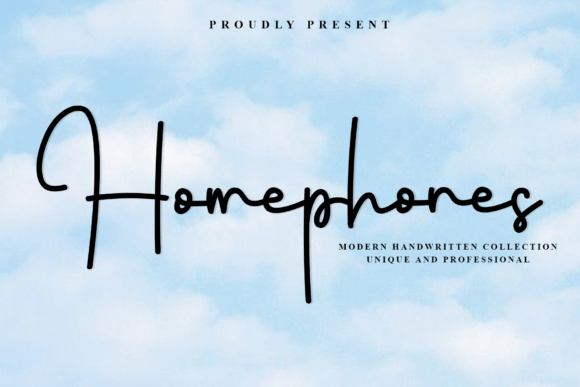
Homephones isn’t just another script font—it’s a thoughtfully crafted, modern handwritten typeface designed for authenticity and impact. Its smooth, generous curves and elongated, fluid strokes mimic the natural rhythm of confident penmanship. That’s why designers, photographers, wedding planners, small business owners, and content creators turn to Homephones when they need something that feels personal, refined, and unmistakably human—not generic or over-processed.
Why People Reach for Homephones (and Why It Often Works So Well)
Unlike many decorative scripts, Homephones balances elegance with readability. Its open letterforms and consistent spacing mean it performs well at larger sizes—ideal for luxury wedding invitations, editorial mastheads, or minimalist product packaging. Photographers use it discreetly in watermarks without sacrificing image integrity. Entrepreneurs building personal brands choose it for logos and social bios because it conveys warmth and intentionality—not just style, but substance.
But here’s what often gets overlooked: Homephones shines brightest when used *with purpose*, not just for aesthetic appeal. Its strength lies in context—not coverage. Using it everywhere dilutes its effect. And misjudging technical details can undermine even the most thoughtful design choice.
Assuming It’s Ready for Every Size and Medium
Homephones was built for display—not body text. Trying to set paragraphs or captions in it at 12–14px will strain readability and weaken communication. It’s also not optimized for screen UIs, app interfaces, or dense digital layouts where clarity trumps flourish. If you’re designing a website hero section or Instagram story overlay, Homephones works beautifully at 36pt+. But for mobile navigation or email footers? Choose a clean sans-serif companion instead.
Better approach: Pair Homephones with a neutral, highly legible typeface like Inter, Lora, or Montserrat. Use it only for headlines, quotes, signatures, or short branded elements—never for long-form reading.
Overlooking Licensing Before Downloading or Embedding
Homephones is a commercial typeface. Free downloads from unofficial sites often deliver outdated versions, missing glyphs, or—worse—malware-infected files. Worse still, some users assume “free to download” means “free to use commercially,” leading to takedowns or legal exposure when used on client work, merchandise, or paid ads.
What to check before downloading: Verify the source. Official distributors include Creative Market, MyFonts, and the foundry’s own site. Confirm the license covers your intended use—web fonts require WOFF/WOFF2 files and proper CSS embedding; print-only licenses won’t support web projects; extended licenses are needed for logos used on physical products like mugs or apparel.
Misreading Its Personality
Homephones leans elegant, not playful. Its graceful strokes suggest quiet confidence—not whimsy or youthfulness. That makes it less suitable for children’s books, tech startup banners, or energetic food branding. One freelance educator told us she chose Homephones for her online course logo, only to find students perceived it as “too formal” for her warm, conversational teaching style.
Better alternative: Test it alongside your brand voice. Read your tagline aloud in Homephones. Does it sound like *you*? If your messaging is upbeat and casual (“Let’s grow together!”), consider a lighter, bouncier script like Brittany Signature or Sofia Pro. Reserve Homephones for moments where sophistication, trust, and timelessness matter most—like a photographer’s signature on fine art prints or a boutique’s monogrammed stationery.
Skipping Kerning and Spacing Adjustments
Even professional fonts benefit from manual refinement. Homephones includes well-designed default spacing—but tight letter combinations (like “To”, “Wa”, or “Fr”) may need subtle kerning tweaks in design tools like Adobe Illustrator or Figma. Auto-kerning features often miss these nuances, resulting in awkward gaps or collisions that quietly erode polish.
Quick fix: Zoom in at 200% and scan word-by-word. Adjust tracking slightly if letters feel crowded or distant. For logotypes, treat each word as a custom lockup—not just typed text.
Ignoring File Format Limitations
Homephones comes in OTF and TTF formats by default. While both work well in desktop apps, neither supports variable weight axes or true web-optimized subsetting. If you’re embedding it on a high-traffic site, unoptimized files slow load times and hurt SEO. And if you need bold or italic variants, note that Homephones is a single-weight script—no built-in stylistic alternates. You’ll need to manually adjust stroke width or opacity for emphasis, not rely on font-weight toggles.
Smart move: Use a webfont service that offers auto-subsetting (like Cloud.typography or Fonts.com) or convert and compress files using tools like Transfonter—then test performance in Lighthouse.
Before You Commit: Three Practical Checks
- Preview it in your real environment: Don’t just look at samples—type your actual headline, name, or tagline in your design software. Try it on your intended background (light, dark, textured). See how it holds up in motion (e.g., animated social posts).
- Review the glyph set: Does it include language-specific characters you need? Standard Homephones supports Latin-based languages (English, Spanish, French, German), but doesn’t cover Cyrillic, Greek, or Vietnamese. Check the specimen PDF before purchase.
- Ask about updates and support: Reputable sellers provide version history and responsive support. If you encounter rendering issues on macOS Monterey or Windows 11, a quick vendor reply matters more than a flashy preview.
Homephones rewards intention. It’s not about adding flair—it’s about reinforcing meaning. When used with care, it becomes part of your brand’s quiet authority: the handwritten note on a luxury gift box, the subtle watermark on a portfolio image, the confident signature beneath a founder’s quote. It doesn’t shout. It resonates.
So whether you’re launching a new venture, refreshing your visual identity, or preparing a once-in-a-lifetime wedding suite—choose Homephones not because it’s beautiful, but because its beauty serves your message. And always pair that choice with attention to detail, licensing clarity, and real-world testing. That’s how elegance becomes effective.