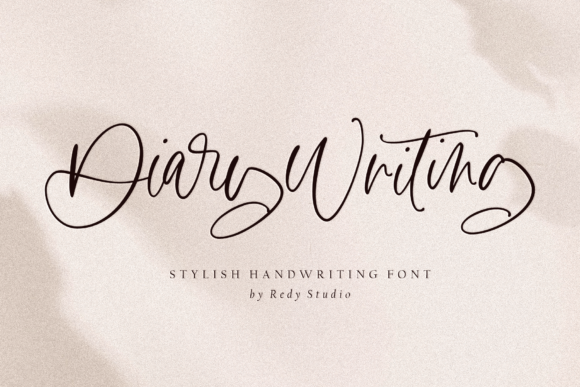
Diary Writing
Diary Writing isn’t just a font—it’s the quiet hum of ink on paper translated into digital form. It’s a handwritten script font that feels personal, unhurried, and intentionally human. If you’ve ever jotted down thoughts in a leather-bound notebook, doodled margins during a meeting, or written a heartfelt note to a friend, you’ll recognize its rhythm. It’s not flashy or overly ornate—just warm, legible, and full of quiet character.
Where You’ll Actually Use Diary Writing (and Why It Fits)
Unlike fonts designed for corporate dashboards or technical documentation, Diary Writing thrives where authenticity matters more than uniformity. Think about the last time you sent a birthday card—you didn’t choose something sterile or geometric. You wanted warmth. That’s Diary Writing’s sweet spot: moments where tone and texture carry as much weight as the words themselves.
It works especially well in contexts where you’re speaking *to* someone—not broadcasting *at* them. A small bakery posting a “Thank You” sign on Instagram? Diary Writing softens the message without sacrificing clarity. A teacher designing a classroom welcome banner? It signals approachability before a single word is read. A freelance illustrator labeling a print collection? It adds craft-level intentionality, not just decoration.
For Creators & Hobbyists
If you design printable planners, stitch embroidery patterns, or hand-letter quotes for wall art, Diary Writing gives your work instant cohesion. Its natural flow makes it ideal for short phrases—“Breathe,” “You’ve Got This,” “Made with Love”—where spacing and rhythm affect emotional resonance. Because it’s PUA encoded, you can pull alternate swashes or ligatures directly from your glyph panel (in Illustrator or Affinity Designer), so your “love” doesn’t look identical every time—just like real handwriting.
For Small Business Owners & Marketers
Local shops, wellness studios, and boutique services often lean into handwritten aesthetics to stand out from algorithm-driven sameness. A yoga studio using Diary Writing on a workshop flyer conveys calm and presence better than a sleek sans-serif ever could. A candle maker applying it to product labels adds tactile charm—especially when paired with kraft paper or matte finishes. Just keep it scoped: use it for headlines, tags, or short callouts—not body copy. Legibility drops fast beyond ~24pt in dense paragraphs.
For Educators & Content Makers
Teachers building morning meeting slides or homeschool parents crafting weekly learning trackers often need fonts that feel inviting—not intimidating. Diary Writing lowers the visual barrier for younger learners or neurodivergent students who respond better to organic shapes over rigid geometry. Bloggers writing reflective posts on mindfulness, journaling, or slow living also find it aligns tonally with their voice—no extra explanation needed. Readers subconsciously register it as “thoughtful,” not “designed.”
For Freelancers & Publishers
When you’re delivering brand assets to a client—say, social templates for a new wellness coach—Diary Writing offers an easy way to suggest personality without overcommitting. It’s versatile enough for Instagram story text, Pinterest pins, or email headers, but distinct enough to avoid blending in with free Google Fonts. And because it’s PUA encoded, you won’t hit roadblocks trying to access flourishes or contextual alternates mid-project. No hunting through layers of OpenType features—just open the glyph panel and pick what fits the mood.
What to Consider Before You Use It
Handwritten fonts walk a fine line between expressive and illegible—and Diary Writing is no exception. It shines brightest at medium to large sizes (20–60pt) with generous letter spacing. Try it in all-caps for impact, but avoid tight tracking or low-contrast color combos (like light gray on white). It’s not built for data tables, legal disclaimers, or multi-line navigation menus.
Also consider context: if your audience skims quickly—say, on mobile or in a busy newsletter—reserve Diary Writing for high-intent moments only: a headline that stops scrolling, a CTA button that feels personal, or a testimonial pull quote that breathes. Let it do one thing well instead of trying to carry everything.
Licensing matters too. While many free handwritten fonts come with usage limits (no merch, no resale), Diary Writing is typically offered with clear commercial rights—meaning you can use it on client projects, sell printables, or brand physical products without second-guessing. Always verify the license with your source, but know that reputable versions are built for real-world workflows—not just hobbyist experiments.
How It Fits Into Your Toolkit—Without Taking Over
You don’t need to rebuild your entire design system around Diary Writing. Think of it as your go-to “voice amplifier”: the font you reach for when you want words to land with sincerity, not speed. Pair it with a clean, neutral sans-serif (like Inter, Lato, or even Helvetica Neue) for balance—headlines in Diary Writing, supporting text in something functional. That contrast does the heavy lifting: warmth + clarity = trust.
And because it’s PUA encoded, there’s no setup friction. No installing plugins or enabling obscure OpenType features. Just load the font, open your design app, and access swashes, stylistic alternates, or ligatures instantly via the glyph panel. That means less fiddling, more focusing on what you actually want to say—and who you want to say it to.
A Few Practical Tips to Start Strong
- Test before committing: Paste your actual headline—not placeholder text—into a mockup. Does it read clearly at the size and background you plan to use?
- Respect hierarchy: Use Diary Writing for one dominant element per layout (e.g., a title or quote), then switch to a highly legible companion font for anything longer than five words.
- Think beyond screens: It prints beautifully on textured paper, foil-stamped cards, or fabric transfers—so if you’re making physical goods, test a proof first.
- Watch the weight: Diary Writing comes in one standard weight. If you need bold or light variants for contrast, pair it intentionally—not layer it.
In the end, Diary Writing isn’t about nostalgia or trend-chasing. It’s about choosing a tool that supports how people actually connect: with honesty, care, and a little imperfection. Whether you’re drafting a note to a student, branding a weekend pop-up shop, or designing a digital journal template, it helps your message feel seen—not just scanned.