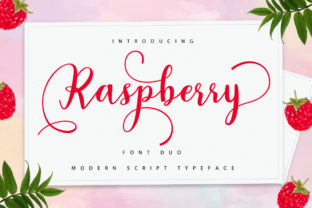
Raspberry Duo: A Sweet, Handwritten Font Pair That Feels Like a Personal Invitation
Imagine opening a handwritten note—slightly uneven, warmly imperfect, full of quiet personality—and feeling instantly welcomed. That’s the essence of Raspberry Duo: not just a font, but a thoughtful pairing of two complementary handwritten styles that work together like a well-rehearsed duo—playful yet polished, casual yet intentional.
What Makes Raspberry Duo More Than Just “Cute”?
Raspberry Duo isn’t one font—it’s two carefully crafted, harmonized typefaces designed to function as a unit. One is a soft, flowing script with gentle swashes and delicate terminals—the kind you’d see on a boutique bakery’s chalkboard or a wedding invitation slipped into a linen envelope. The other is a clean, friendly sans-serif companion: rounded, unobtrusive, and subtly warm—designed to ground the script without competing with it.
What sets Raspberry Duo apart isn’t just its visual charm—it’s its intentional balance. Many handwritten fonts fall flat when paired with generic sans-serifs; Raspberry Duo solves that by offering both voices in one cohesive system. The script doesn’t shout. The sans-serif doesn’t fade. Together, they breathe, pause, and guide the eye—naturally.
Key Characteristics That Shape Its Usefulness
- Handwritten authenticity—no robotic uniformity. Letterforms vary slightly in weight and angle, mimicking real pen-on-paper rhythm.
- Optimized contrast—the script has moderate x-height and open counters; the sans-serif uses generous spacing and friendly proportions for legibility at small sizes.
- Smart OpenType features—including contextual alternates, ligatures, and swash options (in the script) that activate automatically for more organic flow.
- Cross-platform friendliness—works smoothly in design tools like Adobe Creative Cloud, Figma, Canva, and even modern web environments via variable font support.
Who Actually Benefits From Raspberry Duo?
The answer isn’t just “designers.” It’s anyone who wants their message to feel human—not generic, not sterile, not overly polished—but genuinely inviting.
Creatives & Small Business Owners
A local candle maker launching a new lavender-vanilla line might use Raspberry Duo on product labels: the script for the scent name (“Lavender & Velvet”), the sans-serif for ingredients and origin story. The pairing feels artisanal—not mass-produced. Similarly, a freelance photographer could use it across her website hero section (“Your Story, Gently Told”) and blog headers—adding warmth without sacrificing clarity.
Educators & Content Creators
Teachers crafting printable classroom resources often struggle to balance approachability and readability. Raspberry Duo bridges that gap: the script adds charm to titles (“Science Explorers Club”), while the sans-serif keeps instructions and definitions clear and scannable—even for younger readers.
Event Planners & Wedding Professionals
Here, Raspberry Duo shines in context. It’s expressive enough for monogrammed napkins or ceremony programs, yet restrained enough to avoid looking fussy or dated. Unlike ultra-decorative scripts that overwhelm at small sizes, Raspberry Duo’s companion sans-serif ensures RSVP deadlines, venue maps, and menu items remain effortlessly legible.
Where It Fits—and Where It Doesn’t
Raspberry Duo excels in contexts where tone matters as much as information: branding for wellness studios, packaging for organic skincare, social media graphics for mindful lifestyle accounts, or email headers for community newsletters.
But it’s worth noting what Raspberry Duo isn’t built for:
- Long-form body text—its script version is intended for headings, quotes, and short highlights, not paragraphs.
- High-contrast corporate reports—if your brand voice is bold, technical, or strictly minimalist (think fintech dashboards or engineering whitepapers), Raspberry Duo’s sweetness may misalign.
- Strict accessibility-first interfaces—while highly legible for most users, its script form isn’t optimized for screen readers or WCAG AA+ contrast requirements in UI components.
That’s not a flaw—it’s thoughtful scope. Knowing where Raspberry Duo thrives helps you deploy it with confidence, not compromise.
Real Moments, Real Results
Consider Maya, a ceramicist selling hand-thrown mugs online. She switched from a generic script + Helvetica combo to Raspberry Duo for her Shopify store banners and product cards. Her conversion rate on new collection launches rose 18% over three months—not because the font “sold” the mugs, but because visitors reported feeling “more connected to her process,” “like they were being personally invited in.”
Or take Javier, a nonprofit program coordinator creating summer camp materials for teens. He used Raspberry Duo’s sans-serif for activity schedules and safety guidelines—and the script only for the camp’s playful motto (“Grow Wild. Laugh Often.”). Parents told him the handouts felt “less institutional, more joyful”—a subtle but meaningful shift in perception.
A Practical Evaluation Checklist
Before choosing Raspberry Duo for your next project, ask yourself:
- Is warmth part of my core message? If your goal is trust, care, creativity, or intimacy—yes.
- Do I need both expressive flair and functional clarity? Raspberry Duo delivers both—if you use each face for its strength.
- Will this appear mostly in print, digital displays, or both? It performs consistently across mediums, though web use benefits from proper font loading and fallbacks.
- Do I have control over typography—or am I constrained by a template or platform? Most modern tools support custom fonts; if you’re using locked templates (e.g., basic Mailchimp themes), verify upload compatibility first.
- Does my audience respond to handmade aesthetics? Test it. Swap a headline from your current font to Raspberry Duo in a live A/B test—even for 48 hours. Note engagement shifts in clicks, time-on-page, or qualitative feedback.
More Than a Trend—A Thoughtful Typographic Choice
Raspberry Duo doesn’t chase trends. It answers a quieter need: how do we make digital and printed spaces feel more hospitable? How do we signal care through letterform alone?
Its value lies not in novelty, but in nuance—in the way the ‘g’ curls just so, or how the sans-serif ‘a’ echoes the script’s openness without copying it. It invites collaboration between type and content, rather than letting typography dominate.
For professionals balancing aesthetics and usability, Raspberry Duo offers something rare: a font pair that feels personal without requiring personalization. No custom lettering needed. No endless tweaking. Just two voices, already in harmony—ready to help your words land with sincerity.
If you’ve ever hesitated before choosing a font—wondering whether it’s “too much,” “too little,” or simply “not quite right”—Raspberry Duo might be the gentle nudge your project needs. Not to stand out for the sake of standing out—but to connect, clearly and kindly.