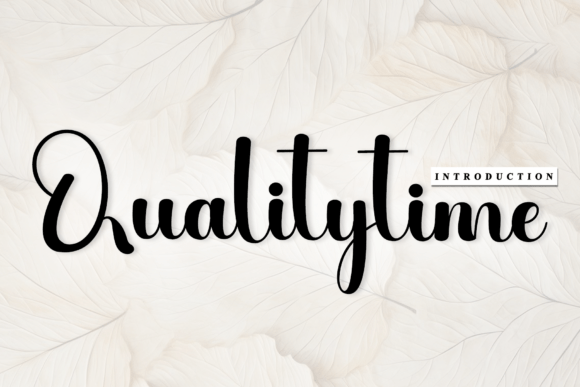
Qualitytime: A Handwritten Font That Builds Recognition and Resonance
Qualitytime isn’t just another script font—it’s a deliberate design decision with measurable impact. Its flowing, confident strokes and carefully considered irregularities give it warmth without sacrificing legibility or professionalism. Unlike many handwritten typefaces that lean too casual or overly ornamental, Qualitytime strikes a rare balance: expressive enough to convey personality, structured enough to support clarity and consistency across touchpoints. For professionals who rely on visual communication—whether launching a boutique brand, designing course materials, crafting social media quotes, or refining a logo—how you choose type signals intention long before the message is read.
Why Strategic Typography Matters More Than You Think
Typography shapes perception faster than copy. A study from the University of Warwick found that readers form judgments about credibility, competence, and likability within 50 milliseconds of encountering text—and font choice is among the strongest visual cues driving those impressions. Qualitytime excels in contexts where authenticity, care, and human connection are strategic priorities: wellness coaching, education platforms, artisanal product branding, or personal storytelling. It doesn’t shout. It invites attention—and holds it—because every letter carries subtle variation, rhythm, and intentionality.
This isn’t about aesthetics alone. It’s about alignment: Does your font reflect the values your audience associates with your work? If you’re an educator emphasizing thoughtful reflection, a therapist building trust, or a small-batch maker highlighting craftsmanship, Qualitytime reinforces those qualities—not as decoration, but as consistent visual grammar.
Where Qualitytime Delivers Real Value (and Where It Doesn’t)
Use Qualitytime where emotional resonance and memorability matter most:
- Logos and primary brand marks—especially for service-based businesses, creative studios, or lifestyle brands seeking approachable distinction;
- Quote graphics and social media visuals—its natural cadence supports readability at smaller sizes while retaining character;
- Course titles, workshop headers, and ebook covers—it conveys expertise with warmth, avoiding the coldness of rigid sans-serifs or the fragility of ultra-thin scripts;
- Email subject lines and landing page headlines—when paired with a clean supporting font (like a neutral sans-serif), it creates hierarchy and contrast that guides attention without overwhelming.
Avoid using Qualitytime for body text, data tables, legal disclaimers, or interfaces requiring rapid scanning. Its charm lies in its singularity—not its utility for dense information. Deploying it where speed and neutrality are required dilutes its strength and risks misalignment with user expectations.
How to Use Qualitytime Intentionally—Not Automatically
Start with purpose, not preference. Before applying Qualitytime, ask: What outcome do I want this element to support? A logo isn’t just identification—it’s the first impression that sets tone and expectation. A quote graphic isn’t just decoration—it’s often the sole point of engagement on a feed. Every use case should pass a simple test: Does this application deepen understanding, reinforce identity, or strengthen emotional connection?
Practical planning tips:
- Define your core brand voice first—is it nurturing? authoritative? playful? grounded? Qualitytime works best when it echoes—not contradicts—that voice;
- Limit usage to one or two high-impact applications—overuse flattens distinction and weakens recall. Reserve it for moments where differentiation matters most;
- Pair thoughtfully—combine Qualitytime with a highly legible, neutral typeface (e.g., Inter, Lato, or Source Sans) for supporting text. Avoid competing scripts or decorative fonts that create visual noise;
- Test at real scale and context—view your logo on a mobile screen, your quote graphic in a dark-mode feed, your course title next to a photo. Legibility and tone shift dramatically outside design software.
Risks of Using Qualitytime Without Context
The biggest risk isn’t technical—it’s strategic drift. Choosing Qualitytime because “it looks nice” or “everyone’s using script fonts” bypasses critical decision-making. When used without clear goals, it can unintentionally signal informality in contexts requiring authority (e.g., financial advising, academic publishing, B2B SaaS), or feel incongruent with audience expectations (e.g., tech startups targeting enterprise buyers).
Another common pitfall: assuming stylistic uniqueness equals brand differentiation. Qualitytime is distinctive—but distinction only becomes advantage when it serves a functional goal. A handmade soap brand benefits from its tactile warmth. A cybersecurity firm likely does not. The font itself doesn’t build trust; consistency, clarity, and relevance do—and Qualitytime supports those only when deliberately anchored to them.
Long-Term Positioning: Beyond First Impressions
Consider how Qualitytime functions over time—not just in launch assets, but across evolving needs. Will it scale as your business grows? Can it adapt to new formats—packaging, video intros, print collateral—without losing integrity? Fonts with strong personality require stronger systems around them. That means documenting usage rules early: minimum size thresholds, color contrast ratios, spacing guidelines, and fallbacks for accessibility compliance.
One underused strength of Qualitytime is its capacity for evolution. Because its letterforms carry nuance—not gimmick—you can introduce subtle variations (e.g., selective letter spacing, intentional kerning adjustments, or restrained color shifts) to signal growth or seasonal shifts without abandoning recognition. This kind of controlled flexibility is rare in script fonts and valuable for creators managing long-term audience relationships.
Making the Decision: Is Qualitytime Right for Your Next Project?
Ask three questions before committing:
- Does this project prioritize emotional resonance over functional speed? If users need to act quickly (e.g., emergency instructions, dashboard metrics), Qualitytime isn’t the tool.
- Is consistency across platforms feasible? Check rendering on iOS, Android, Windows, and web browsers. Some handwritten fonts degrade in certain environments—Qualitytime holds up well, but always verify in your actual deployment stack.
- Does it complement—not compete with—your message? Read your headline aloud while looking at the rendered text. Does the tone match what you’re saying? If your copy says “Trusted since 2012” but the font reads like a café chalkboard, reconsider.
When aligned with intention, Qualitytime becomes more than typography—it becomes part of your communication infrastructure. It supports memory formation (studies show distinctive fonts improve recall by up to 27% in short-term tasks), strengthens visual cohesion across channels, and quietly signals that you’ve invested thought—not just effort—into how people experience your work.
That investment pays dividends: in higher engagement rates on quote-driven content, in stronger brand recognition after limited exposure, in deeper audience trust built through consistent, human-centered expression. But none of that happens automatically. It happens when Qualitytime is chosen—not as an afterthought, but as a strategic lever calibrated to your goals, your audience, and your long-term vision.