Montages: A Strategic Choice for Human-Centered Visual Language
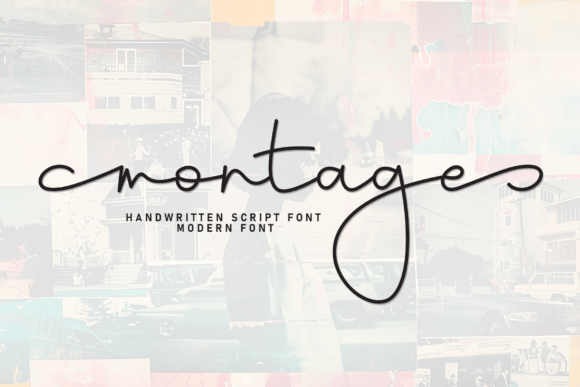
Typography is rarely neutral. Every font carries implicit signals—about tone, intention, and audience alignment. Montages stands apart not because it’s decorative, but because it functions as a precise visual instrument: a modern handwritten script font engineered for clarity, elegance, and contextual resilience. It bridges the warmth of analog gesture with the precision required in digital-first environments—from editorial layouts to e-commerce banners, from luxury skincare labels to intimate wedding stationery. Its value lies not in novelty, but in its consistency of performance across real-world constraints.
Why Montages Fits Into Intentional Design Strategy
Choosing a typeface isn’t about preference alone—it’s a foundational decision that shapes perception, supports hierarchy, and reinforces brand logic. Montages earns strategic relevance through three interlocking qualities: readability under complexity, emotional resonance without excess ornamentation, and adaptability across scales and surfaces. Its smooth monoline paths avoid visual noise; its wide character spacing prevents crowding in tight compositions; and its dramatic ascenders and deep terminal loops introduce rhythm—not randomness. That rhythm reads as confident, unhurried, and human. In an era saturated with algorithmic polish and synthetic uniformity, that distinction matters.
For entrepreneurs launching a premium skincare line, Montages doesn’t just “look nice” on a serum bottle—it quietly signals craftsmanship, attention to detail, and tactile care. For a freelance photographer watermarking fine art prints, it avoids competing with image texture while asserting authorship with grace. For a lifestyle blogger designing a logo, it communicates approachability without sacrificing sophistication. These aren’t aesthetic bonuses—they’re functional outcomes rooted in typographic behavior.
Where Montages Delivers Measurable Value
Strategic typography pays dividends where clarity meets context. Consider these high-impact use cases:
- Fine photography watermarks: Montages maintains legibility over soft-focus backgrounds or grainy film scans thanks to sharp, optimized outlines—no blurring, no pixelation, even at small sizes.
- Upscale cosmetic and skincare branding: Its airy spacing and organic flow support clean, minimalist packaging systems while evoking hand-mixed formulations and artisanal integrity.
- Contemporary fashion lookbook headings: Paired with high-contrast imagery, Montages creates breathing room and narrative pause—guiding the eye without shouting.
- Romantic wedding stationery suites: Its soaring ascenders and sweeping terminals echo calligraphic tradition, but with contemporary restraint—ideal for couples seeking elegance without formality.
- Minimalist lifestyle blog logos: As a primary mark, Montages conveys voice and point of view instantly—no tagline needed, no explanation required.
Each application succeeds because Montages was built for coexistence—not dominance. It doesn’t demand attention; it earns it through harmony.
How to Use Montages With Purpose—Not Just Decoration
Using Montages effectively begins with intention—not inspiration. Ask: What role must this text play? Is it identifying, guiding, affirming, or inviting? If the answer is unclear, the font won’t clarify it. Start by mapping usage to function:
- Identify first-use context: Will it appear on a pale pastel backdrop? Over a hazy retro photo collage? At 12px in a mobile navigation bar? Test early—not just visually, but contextually.
- Define hierarchy before styling: Montages excels at headline weight and short-form emphasis (e.g., “Botanical Serum,” “Spring Edit,” “Hand-Poured”). Avoid extended body copy—it’s not designed for paragraphs.
- Pair deliberately: Its fluidity pairs best with structurally grounded sans-serifs (e.g., Inter, Poppins, or Neue Haas Grotesk) or low-contrast serifs. Avoid other scripts or highly decorative fonts—they’ll compete rather than complement.
- Respect scale thresholds: Below 16px, ascenders and terminals begin to lose definition. Above 72px, spacing may feel overly generous unless balanced with generous line height and negative space.
These aren’t restrictions—they’re guardrails that preserve Montages’s core strengths. Ignoring them risks visual ambiguity or unintended informality.
Risks of Using Montages Without Contextual Alignment
A font can’t compensate for weak strategy—and Montages is especially vulnerable to misalignment. Because it carries such strong tonal cues (luxury, intimacy, craft), deploying it without supporting context can backfire. For example:
- Using Montages on a tech startup’s SaaS dashboard undermines credibility—the aesthetic contradicts expectations of speed, precision, and scalability.
- Applying it across all brand touchpoints (including data-heavy reports or error messages) dilutes its impact and confuses user expectations.
- Selecting it solely because it’s “trendy” or “Instagrammable,” without auditing whether it reflects actual brand values or customer perception, leads to dissonance—not differentiation.
The risk isn’t poor aesthetics—it’s eroded trust. When visual language contradicts operational reality (e.g., a “handcrafted” font paired with mass-produced, generic product descriptions), audiences notice. They may not articulate why, but they’ll sense inconsistency.
Long-Term Positioning: Why Montages Supports Sustainable Branding
Short-term trends fade. Long-term brands endure because their visual language evolves with intention—not impulse. Montages supports sustainability in two concrete ways: first, through technical durability—its vector outlines render crisply across devices, resolutions, and output methods (print, web, embroidery, foil stamping). Second, through semantic stability—it communicates timeless human qualities (care, authenticity, intention) rather than fleeting stylistic tropes (glitch effects, exaggerated contrast, or artificial distress).
Consider how a wedding stationer might use Montages: not just for one couple’s suite, but as a consistent signature across portfolios, social bios, and business cards. Over time, that repetition builds recognition—not just of the font, but of the values it represents. The same applies to a skincare founder: using Montages across product names, ingredient callouts, and limited-edition packaging creates cohesion that customers internalize. That cohesion becomes equity.
Practical Integration Tips for Real Workflows
Adopting Montages successfully means integrating it into existing tools and habits—not adding friction. Here’s how professionals actually make it work:
- Designers: Load Montages into your Figma or Adobe library with pre-built text styles (H1–H3, captions) that lock spacing, size, and tracking—so team members apply it consistently without guesswork.
- Marketers: Define clear usage rules in your brand guidelines: “Montages is used only for campaign headlines, product names, and hero section quotes. Never for body copy, CTAs, or legal text.” Clarity prevents drift.
- Bloggers & creators: Use Montages in your logo and featured post titles—but default to a highly legible system font (like Inter or Lato) for article body text. Let each font do what it does best.
- Small business owners: Before purchasing, test Montages in your actual environment: paste sample text over a screenshot of your Shopify homepage or Instagram Story template. Does it read? Does it feel aligned?
These aren’t theoretical suggestions—they reflect documented patterns among users who’ve retained Montages across multiple projects and years, not as a passing experiment, but as a deliberate tool.
Final Thought: Typography as Decision-Making Infrastructure
Every time you choose Montages, you’re making a quiet but consequential decision about how your work will be perceived, remembered, and trusted. It works because it respects both the viewer’s attention and the creator’s intent. It doesn’t shout. It settles—in a way that feels earned, not applied. That makes it less of a “font choice” and more of a design discipline: one that rewards patience, planning, and purposeful restraint. Use it where humanity needs to show—not as decoration, but as declaration.