Creatives: A Handwritten Font That Supports Strategic Communication—Not Just Aesthetic Choice
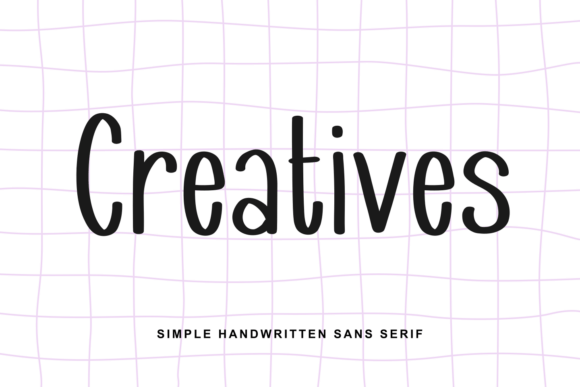
Choosing a font is rarely just about looks. When you select Creatives, you’re not picking a decorative element—you’re selecting a communication tool with distinct behavioral and perceptual effects. Creatives is a playful, tall-lettered handwritten typeface built on smooth curves and a relaxed rhythm. Its warmth and approachability aren’t accidental; they’re design decisions that influence how your audience reads, interprets, and remembers your message. For entrepreneurs, educators, marketers, and small business owners, that distinction matters—not as a stylistic footnote, but as part of deliberate planning.
Why Creatives Works Where Other Handwritten Fonts Don’t
Many handwritten fonts sacrifice clarity for charm—or worse, feel overly stylized, juvenile, or inconsistent at scale. Creatives avoids those pitfalls by balancing personality with precision. Its tall x-height improves legibility at smaller sizes, while its even spacing and open counters maintain readability in both digital and print contexts. Unlike script fonts that require careful kerning or contextual alternates, Creatives delivers consistent rhythm without manual adjustment. That means less time troubleshooting typography—and more time focusing on messaging, positioning, and outcomes.
This reliability makes Creatives especially valuable when building brand systems where tone must remain cohesive across touchpoints: a social media post, a product label, an email header, and a workshop handout can all share the same voice because Creatives carries expressive weight without visual noise.
Strategic Use Cases—And When to Pause
Creatives excels in situations where human connection, authenticity, or gentle emphasis is the goal—not decoration. Consider these grounded applications:
- Branding for service-based businesses: Coaches, therapists, educators, and wellness practitioners often rely on trust and relatability. Using Creatives in logos, website headers, or email signatures reinforces warmth without undermining professionalism—especially when paired with a clean sans-serif for body text.
- Social media storytelling: Short-form platforms reward immediacy and emotional resonance. A quote graphic set in Creatives feels more personal than a generic serif, increasing the likelihood of pause, reflection, and sharing—particularly for audiences aged 30–50 who respond to sincerity over polish.
- Packaging for artisanal or eco-conscious products: Consumers increasingly associate handmade aesthetics with care, transparency, and intentionality. Creatives supports that narrative credibly—provided it’s used selectively (e.g., on ingredient lists or origin stories) rather than across every line of regulatory copy.
- Classroom materials and learning resources: Educators report higher student engagement with visuals that feel inviting, not intimidating. Creatives lowers perceived cognitive load in worksheets, slide titles, or bulletin board labels—without compromising clarity.
That said, Creatives isn’t universally appropriate. Avoid using it for legal disclaimers, data-heavy tables, multi-paragraph blog posts, or any context demanding neutrality or urgency. Its rhythm invites pause—not scanning. Misapplying it risks undermining credibility, especially in B2B, finance, healthcare, or technical domains where clarity and authority take priority over charm.
Intentional Use Starts With Purpose—Not Preference
Before dropping Creatives into a layout, ask: What outcome am I trying to support? Not “Does this look nice?” but “Will this help my audience feel seen, understand faster, remember longer, or act more confidently?” That shift—from aesthetic preference to functional intent—is what separates thoughtful design from decorative habit.
For example, a freelance writer launching a newsletter might use Creatives only in the subject line (“Your weekly dose of calm ideas ✨”)—a subtle cue that this isn’t another transactional update, but a curated, human-scaled moment. The rest of the email remains in a highly legible sans-serif. That contrast works *because* Creatives is limited, purposeful, and aligned with a clear communication goal.
Similarly, a small-batch candle brand could apply Creatives to scent descriptions (“smoke + cedar + slow mornings”) on packaging—but keep safety instructions and net weight in a neutral, accessible typeface. The result isn’t inconsistency—it’s layered communication: emotion first, information second, always with respect for the user’s needs.
Planning for Long-Term Value—Not Just One-Off Impact
Fonts contribute to brand equity over time—not just in a single campaign. If you adopt Creatives, treat it like a strategic asset: document where and why it’s used, test its performance across devices and age groups, and revisit usage guidelines annually. Does it still reflect your evolving voice? Does it scale well in new formats (e.g., app interfaces or voice-assisted previews)? These aren’t design questions alone—they’re operational and experiential ones.
Also consider accessibility. While Creatives meets basic readability thresholds, its handwritten nature means it shouldn’t be the sole typeface in WCAG-compliant materials. Always pair it with a tested, high-contrast, screen-reader-friendly companion—and never rely on it for critical navigation or form labels.
Risks of Unintentional Use
The biggest risk with Creatives isn’t technical limitation—it’s misalignment. Using it because “handwritten fonts are trending” or “it matches my mood board” introduces friction between intention and impact. You may unintentionally signal informality in contexts requiring authority, or overwhelm users who need clarity over charm.
Another common pitfall: overuse. When Creatives appears everywhere—headlines, captions, buttons, footers—it loses its expressive power. Like any strong voice, it gains weight through restraint. Think of it as a spoken tone: warm and conversational, yes—but not shouted, not whispered, and never used to say everything at once.
Practical Next Steps for Intentional Adoption
If you’re evaluating whether Creatives fits your goals, start small and measurable:
- Run a controlled test: Apply Creatives to one recurring element—say, testimonial quotes on your homepage—and track bounce rate, time-on-page, or scroll depth for two weeks. Compare against your current version.
- Map usage to audience segments: Does your primary demographic respond more positively to warmth (e.g., parents, creatives, wellness seekers) or precision (e.g., engineers, procurement managers, compliance teams)? Let that guide where Creatives earns space—and where it doesn’t.
- Build a lightweight style guide: Define no more than three approved uses (e.g., “H2 headings in blog posts,” “Product taglines on packaging,” “Email signature name”) and one hard exclusion (“Never in pricing tables or legal footers”). Clarity here prevents drift.
- Review with real-world constraints: Print a sample at actual size. View it on a low-end mobile screen. Ask a colleague over 55 to read it aloud. Design decisions hold up—or don’t—under practical conditions, not just in Figma.
Finally, remember that Creatives doesn’t replace strategy—it amplifies it. A well-positioned brand with unclear messaging won’t improve because of a friendly font. But a brand with strong values, thoughtful structure, and intentional voice? Creatives helps that voice land with greater resonance, recognition, and recall.
Use it not to make things “cuter,” but clearer—to humanize without diluting, to distinguish without distracting, and to express with consistency. That’s how a handwritten font becomes more than a detail. It becomes part of your decision-making infrastructure.