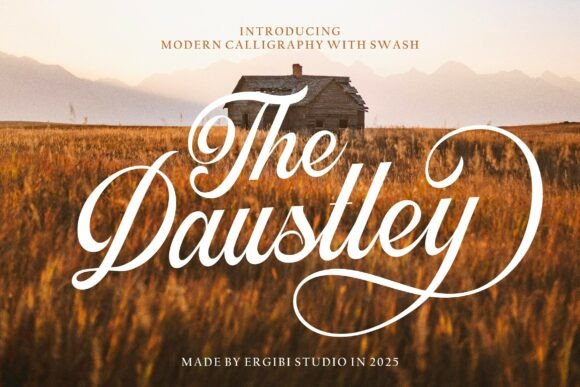
Daustley: A Strategic Choice for Elegant, Intentional Typography
Daustley isn’t just another calligraphy font—it’s a design decision with measurable impact. When you choose Daustley, you’re selecting a visual language rooted in grace, rhythm, and human intention. Its smooth, flowing strokes and carefully balanced letterforms don’t merely look beautiful; they signal care, refinement, and attention to detail—qualities that resonate deeply with audiences across industries and platforms.
Why Daustley Fits Real-World Strategy—Not Just Aesthetics
Typography is rarely neutral. It shapes perception before a single word is read. Daustley excels where tone matters as much as content: wedding invitations that convey warmth and reverence, brand identities that balance tradition with modernity, social media posts that stand out without shouting, and educational materials that invite engagement rather than passive scanning. Its strength lies in its ability to support—not override—your message.
For entrepreneurs launching a boutique service, Daustley can reinforce premium positioning without relying on expensive photography or complex layouts. For educators designing workshop handouts or course certificates, it adds quiet authority and approachability. For freelancers building personal brands, it offers a consistent, recognizable voice across logos, email signatures, and portfolio thumbnails—without requiring custom illustration.
When Daustley Delivers Strategic Value—and When It Doesn’t
Daustley shines in contexts where legibility at moderate sizes, emotional resonance, and typographic distinction are priorities. It performs exceptionally well in print (invitations, stationery, packaging), short-form digital use (Instagram story text overlays, Pinterest pins, email headers), and branded assets like monograms or signature lines.
It is less effective—and potentially counterproductive—in long-form body copy, data-heavy dashboards, accessibility-critical interfaces, or environments where fast scanning is essential (e.g., legal disclaimers, product spec sheets). Using Daustley for paragraph text risks undermining readability, slowing comprehension, and diluting trust—especially for readers with visual processing preferences or screen reader dependencies.
This isn’t a limitation of the font—it’s a matter of alignment. Daustley works best when matched to purpose, audience, and medium—not applied broadly because it “looks nice.” That distinction separates thoughtful typography from decorative habit.
Practical Use Cases with Measurable Outcomes
- Wedding Branding: Couples using Daustley across save-the-dates, menus, and signage report higher guest engagement and more frequent photo sharing—likely due to the font’s cohesive, memorable presence. The alternate characters allow subtle personalization (e.g., customizing initials or monograms) without needing bespoke illustration.
- Small Business Logos: A local apothecary, ceramic studio, or independent bookstore can use Daustley in their logo to suggest craftsmanship and care—reinforcing values that differentiate them from algorithm-driven competitors. Paired with a clean sans-serif for supporting text, it creates hierarchy and clarity.
- Social Media Storytelling: Coaches and consultants using Daustley for quote graphics or launch announcements see improved retention metrics. The rhythm of the letterforms encourages slower reading, increasing the chance the core idea lands—not just scrolls past.
- Educational Materials: Workshop facilitators applying Daustley to certificate headers or module titles create psychological “bookends” that signal importance and completion—supporting learning retention through visual punctuation.
How to Use Daustley With Intention—Not Instinct
Start with your goal—not the font. Ask: What action should this piece inspire? What feeling should linger after someone sees it? If the answer is “trust,” “calm,” “celebration,” or “thoughtful craftsmanship,” Daustley may be appropriate. If the answer is “urgency,” “technical precision,” or “immediate clarity,” reconsider.
Test early and often. Render Daustley at actual usage size—on both desktop and mobile screens—and alongside your secondary typeface. Does contrast remain clear? Does spacing feel generous, not cramped? Does the weight hold up in low-resolution environments (e.g., printed flyers on uncoated paper)? These aren’t stylistic nitpicks—they’re operational checkpoints.
Leverage its built-in alternates deliberately. Don’t swap characters randomly to “make it unique.” Instead, use them to resolve awkward letter combinations (e.g., replacing a default “st” ligature with a smoother alternate), emphasize key words in headlines, or introduce variation across multi-line quotes. Each choice should serve rhythm, meaning, or hierarchy—not novelty alone.
Risks of Using Daustley Without Context
The most common misstep isn’t technical—it’s strategic drift. When designers reach for Daustley reflexively—because it’s trending, because a competitor uses it, or because it feels “creative”—they risk misalignment between form and function. A law firm using Daustley for client intake forms may unintentionally signal informality over reliability. A tech startup deploying it across error messages undermines credibility through tonal mismatch.
Another underdiscussed risk is visual fatigue. Because Daustley’s strokes are expressive and connected, overuse—even in small doses—can dilute impact. A brand that applies it to every headline, button label, and testimonial quote loses its power through repetition. Reserve it for moments that truly benefit from its character: openings, transitions, signatures, and emotional anchors.
Planning Tips for Long-Term Typographic Health
- Define your typographic roles first: Assign Daustley to one specific function (e.g., “headline + signature only”) and stick to it across all touchpoints. Consistency builds recognition faster than variety.
- Document usage rules: Note minimum sizes, acceptable color contrasts, pairing guidelines, and prohibited contexts (e.g., “never used below 18pt in print,” “never paired with script fonts”). Share this with collaborators to maintain integrity.
- Review annually: Reassess whether Daustley still reflects your evolving brand voice and audience expectations. Markets shift. So should your typographic strategy—intentionally, not reactively.
- Pair with purpose: Daustley gains strength when contrasted thoughtfully. A sturdy, neutral sans-serif (like Inter, Poppins, or Montserrat) provides balance, grounding, and scalability—letting Daustley breathe while ensuring usability remains intact.
Final Consideration: Typography as Part of Your Operating System
Treat Daustley not as decoration but as infrastructure—as part of your communication operating system. Like choosing a CRM or project management tool, selecting and applying a font involves trade-offs: speed vs. nuance, consistency vs. flexibility, familiarity vs. distinction. Daustley prioritizes nuance, distinction, and human-centered expression. That makes it powerful—but only when deployed within a framework of clear goals, audience insight, and medium-aware execution.
If your aim is to build something that endures—whether a brand, a course, an event, or a creative practice—Daustley supports longevity not through trendiness, but through time-tested qualities: rhythm, restraint, and resonance. It doesn’t shout. It invites. And in an age of relentless noise, that invitation may be your most valuable asset.