Bellmora: A Modern Script Font for Elegant, Handwritten-Inspired Typography
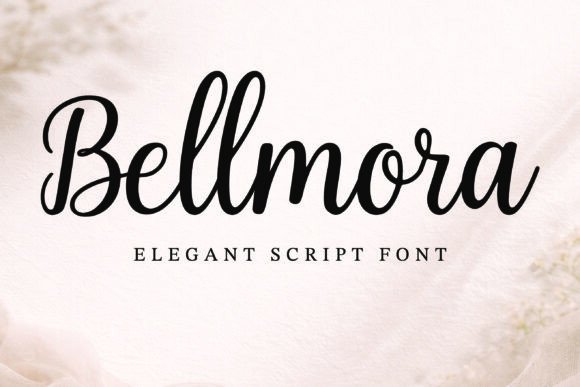
Bellmora is a contemporary script font designed to evoke the fluidity and expressiveness of natural handwriting while maintaining refined typographic structure. Its letterforms feature smooth, connected curves, subtle contrast in stroke weight, and a gentle rhythm that supports readability without sacrificing character. Unlike highly decorative or exaggerated scripts, Bellmora balances personality with restraint—making it suitable for professional applications where warmth and sophistication are both required.
People often explore Bellmora when seeking a typeface that conveys romance, intimacy, or timeless elegance—particularly for projects where tone and emotional resonance matter as much as legibility. Common use cases include wedding stationery, boutique branding, artisanal product packaging, social media visuals, and editorial layouts focused on lifestyle or luxury themes. Its design intent is clear: to offer an accessible yet distinctive script option that avoids cliché while remaining grounded in real-world usability.
Why Bellmora May Align With Your Design Goals
Bellmora’s strengths lie in its consistency and intentionality. Each glyph is carefully crafted to support seamless word-level flow, especially in lowercase settings. The font includes standard ligatures and contextual alternates that enhance authenticity—helping text feel less “typed” and more thoughtfully composed. This makes it particularly effective in short-form, high-impact contexts: logos, headlines, invitation suites, and Instagram quote graphics.
Its romantic and feminine character stems from organic spacing, soft terminals, and slight upward tilt in ascenders—not from exaggerated flourishes. As a result, Bellmora retains clarity at medium sizes (14–24 pt) on screen and in print, provided sufficient contrast and spacing are maintained. It also scales well across formats: from embossed foil on wedding paper to responsive web headers using variable font technology (if supported in the version you license).
For designers working with brand identity systems, Bellmora pairs predictably with clean, neutral sans-serifs (e.g., Inter, Lora, or Montserrat) for body text or supporting copy. This contrast reinforces hierarchy without competing visually—supporting a cohesive, polished aesthetic.
Practical Considerations and Limitations
Like most script fonts, Bellmora is not intended for extended reading. Its connected letterforms and reduced x-height can hinder legibility in long paragraphs or small sizes (<12 pt). It is not a replacement for a functional text face—and should not be used for body copy, legal disclaimers, accessibility-critical interfaces, or environments with low-resolution displays.
Another consideration is licensing. Bellmora is typically distributed as a commercial font, meaning free usage is restricted. Users must verify whether their intended application (e.g., client deliverables, SaaS platform integration, or merchandise printing) falls within the scope of their license. Some versions may lack full language support beyond basic Latin characters, limiting use for multilingual projects unless extended glyphs are explicitly included.
Technical implementation also matters. While modern browsers handle OpenType features like ligatures increasingly well, fallback behavior varies. If Bellmora is loaded via web font service, ensure proper font-display settings to avoid invisible text during load. For print, embedding fonts correctly in PDFs or vector files prevents substitution errors—especially important for client-facing deliverables like invitations or packaging mockups.
When Bellmora Is a Strong Fit
Bellmora excels in scenarios where visual tone directly supports messaging intent. Consider it for:
- Wedding and event branding—invitations, menus, signage—where personalization and emotional warmth are central.
- Luxury or lifestyle brands targeting audiences that value craftsmanship, heritage, or quiet confidence (e.g., apothecaries, fine stationery, independent fashion labels).
- Social media assets requiring quick visual recognition—such as Instagram story text overlays or Pinterest quote pins—where brevity and mood are prioritized over dense information.
- Packaging for premium products (e.g., candles, teas, skincare) where tactile quality and perceived value benefit from handwritten-inspired typography.
In these cases, Bellmora’s ability to signal care, attention to detail, and human touch adds measurable value—provided it’s applied selectively and with appropriate supporting typography.
When Alternatives May Be More Appropriate
If your project demands versatility across multiple weights, widths, or language sets, Bellmora’s single-style focus may present constraints. Fonts like Playfair Display (with its robust serif + script hybrid variants) or Quicksand (for friendly, rounded alternatives) offer broader typographic systems—useful for evolving brand needs.
For digital-first applications requiring high accessibility, consider pairing a script headline font like Bellmora with WCAG-compliant body text rather than relying on script alone. Similarly, if your audience includes readers with dyslexia or low vision, prioritize fonts with strong character differentiation and open counters—even if that means choosing a less stylistically distinctive option.
Finally, if budget or licensing complexity is a concern, free or open-source alternatives—such as Allura or Caveat—offer similar expressive qualities with fewer restrictions. These may serve adequately for personal projects, prototypes, or early-stage brand exploration before committing to a commercial purchase.
Making an Informed Choice
Evaluating Bellmora isn’t about whether it’s “good” or “bad”—it’s about fit. Start by clarifying your primary objective: Is the goal to reinforce brand voice, guide user attention, or evoke a specific feeling? Then assess how much typographic flexibility your project requires. Ask yourself:
- Will this font appear mostly in large, isolated settings—or will it need to scale down or integrate into complex layouts?
- Do I have control over surrounding typography, color, and spacing—or will Bellmora need to carry visual weight independently?
- What are the technical and legal boundaries of my intended use? Does the license cover web embedding, app usage, or resale of derivative designs?
Testing Bellmora in context is essential. Render sample text alongside your actual imagery, colors, and layout constraints—not just in a font preview tool. Compare it side-by-side with two alternatives: one more restrained (e.g., a classic serif), and one more expressive (e.g., a bolder script). Observe how each affects tone, balance, and perceived credibility.
Ultimately, Bellmora serves best when chosen deliberately—not because it’s stylish, but because its characteristics match functional and communicative requirements. Its value lies in its specificity: a well-designed tool for particular jobs, not a universal solution. Understanding those boundaries helps ensure it enhances, rather than complicates, your design outcome.