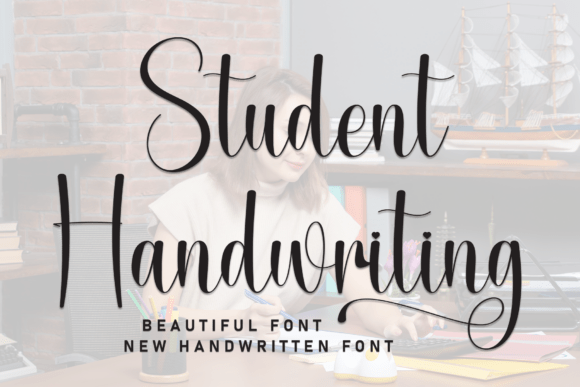
Student Handwriting: Warm, Lively & Uniquely Human
There’s something quietly powerful about handwriting that feels genuine—not perfectly uniform, not sterile or algorithmically precise, but alive with rhythm, variation, and quiet intention. Student Handwriting captures that feeling in typographic form: a display font designed to echo the warmth of ink on paper, the slight tilt of a pen mid-sentence, the gentle inconsistency that signals humanity behind the message. It’s not a script meant for body text or long paragraphs. Instead, it thrives where tone matters most—where you want your audience to pause, smile, feel invited in.
Why Handwritten Typography Still Resonates—Especially Today
In an age saturated with sleek sans-serifs and AI-generated visuals, handwritten fonts like Student Handwriting offer subtle but meaningful contrast. They don’t shout—they lean in. That makes them especially effective when authenticity and emotional resonance are central goals: think wedding stationery that reflects the couple’s personality, a small-batch product label that stands out on a crowded shelf, or a classroom poster that feels welcoming rather than institutional.
This isn’t nostalgia for its own sake. Research in visual communication shows that human-like letterforms trigger stronger affective responses—readers perceive messages as more sincere, approachable, and trustworthy. For educators designing learning materials, freelancers pitching creative services, or local businesses building community loyalty, that emotional shorthand is practical leverage—not just aesthetic flair.
Where Student Handwriting Delivers Real Value
For wedding professionals and couples planning DIY invitations: A single line of names in Student Handwriting can anchor an entire design system. Its balanced mix of charm and refinement avoids looking childish or overly casual—critical when honoring a milestone moment. Unlike many playful scripts, it scales well at larger sizes without losing legibility or warmth, making it ideal for ceremony signage, menu cards, or even monogrammed napkins.
For small business owners and makers: If your brand voice leans toward friendly expertise—say, a herbalist crafting custom tea blends or a ceramicist selling hand-thrown mugs—Student Handwriting reinforces that ethos visually. Used sparingly (a shop name on packaging, a tagline on social banners), it adds distinctiveness without sacrificing clarity. It works especially well alongside clean, neutral typefaces—creating contrast that guides attention without overwhelming.
For educators and nonprofit communicators: When inviting families to a school fundraiser or sharing student artwork online, tone shapes engagement. A flyer set entirely in rigid corporate fonts may unintentionally signal distance or formality. Swapping the headline or event title to Student Handwriting softens the entry point—making information feel more accessible and personally curated.
What Makes This Font Stand Out—Beyond the “Handwritten” Label
Not all handwritten fonts achieve the same effect. Some lean too far into whimsy; others feel stiff or digitally traced. Student Handwriting distinguishes itself through intentional imperfection: subtle baseline shifts, varied stroke weight that mimics real pen pressure, and open letterforms that breathe on the page. These details aren’t decorative—they support readability at display sizes while preserving expressive nuance.
It also avoids common pitfalls. There’s no excessive swash or ligature overload that could hinder quick scanning. Uppercase letters maintain presence without dominance, and lowercase forms retain friendliness without sacrificing structure. That balance means it adapts across mediums—whether printed on textured cotton paper or rendered crisply on a retina screen.
Practical Tips for Using Student Handwriting Well
Like any strong typographic tool, its impact depends on thoughtful application:
- Use it for emphasis, not exposition. Reserve it for headlines, quotes, names, short calls-to-action—or anywhere you want to highlight feeling over function.
- Pair intentionally. Contrast is key. Try pairing with a warm, humanist sans-serif (like Lato or Inter) for supporting text. Avoid competing handwritten or overly decorative fonts nearby.
- Test at actual size. What reads beautifully at 48pt on screen may blur at 24pt in print. Always preview in context—especially for physical goods like greeting cards or signage.
- Consider licensing scope. If you’re a designer using it across client projects, verify whether your license covers commercial redistribution (e.g., in editable templates sold on Creative Market).
When to Pause and Consider Alternatives
Student Handwriting shines in contexts where warmth and approachability enhance—not obscure—your message. But it’s not universal. It won’t serve well for data-heavy reports, technical documentation, multilingual content with complex diacritics (its character set is optimized for English and common Western European languages), or branding requiring strict visual consistency across dozens of touchpoints.
If your project demands high legibility at small sizes, broad language support, or ultra-modern minimalism, other options may align better—even if they lack the same tactile charm. The goal isn’t to default to handwritten fonts, but to choose typography that supports your intent, audience, and medium with integrity.
A Thoughtful Choice for Meaningful Communication
Typography is never neutral. Every font carries associations—some conscious, many subconscious. Choosing Student Handwriting signals care: care in how words land, care in how people feel when they read them, care in honoring the human dimension of communication. That intentionality resonates with audiences who value authenticity over polish, connection over perfection.
Whether you’re a freelance illustrator adding personality to your portfolio site, a teacher creating joyful classroom resources, or a startup founder defining your brand voice early on—this font offers more than visual interest. It’s a quiet collaborator in shaping perception, reinforcing values, and making space for warmth in a fast-moving world.
Used with purpose, Student Handwriting doesn’t just decorate text—it invites attention, encourages empathy, and reminds us that behind every message is a person, reaching out.