Deep Font: The Bold Handwritten Script That Commands Attention
Imagine a logo that pulses with energy. A concert poster that feels like it’s moving before you even read the headline. A social media story that stops the scroll—not with flash, but with intensity. That’s the power of Deep: a modern handwritten script font designed not just to be seen, but to be felt.
What Is Deep—and Why Does It Stand Out?
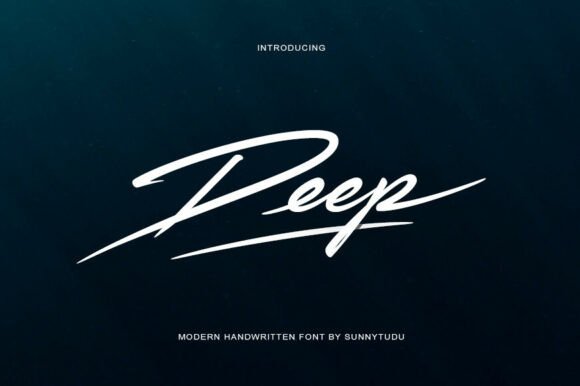
Deep is a premium display typeface classified as a bold, expressive handwritten script. Unlike delicate calligraphy fonts or rigid sans-serifs, Deep merges raw human gesture with refined digital precision. Its defining traits include:
- Sweeping, high-contrast strokes—thick downstrokes paired with razor-thin upstrokes create dramatic rhythm;
- Dynamic curves and exaggerated terminals that suggest motion, speed, and confidence;
- Intentional irregularity—subtle variations in letter spacing, baseline alignment, and stroke weight preserve authenticity without sacrificing legibility;
- A strong vertical stress and forward-leaning slant, giving text an unmistakable sense of momentum.
These aren’t accidental quirks—they’re carefully engineered features. Every curve was drawn, tested, and fine-tuned to balance personality with professionalism. That’s why Deep doesn’t just look “handwritten”; it looks alive.
The Purpose Behind the Power
Fonts are tools—and Deep was built for one clear purpose: high-impact visual communication. It’s not meant for body text in a whitepaper or long-form blog posts. Instead, Deep excels where emotion, identity, and immediacy matter most.
Think of it as the typographic equivalent of a spotlight: narrow in scope, but intensely focused. Its strength lies in instant recognition and emotional resonance. When viewers see Deep, they don’t just register words—they absorb tone, energy, and intent.
Where Deep Delivers Real-World Impact
Because of its commanding presence and stylistic intensity, Deep shines across several key creative domains:
- Branding & Identity: Startups in fitness, streetwear, music tech, or wellness use Deep to signal boldness and authenticity. For example, a boutique boxing gym might use Deep in its logo to convey grit and motion—without saying a word about strength.
- Sports Graphics & Event Promotion: From tournament banners to athlete spotlight reels, Deep adds kinetic energy. Its forward slant mimics sprinting form; its thick strokes echo muscle definition.
- Music Covers & Artist Visuals: Whether it’s a lo-fi hip-hop EP or an indie rock single, Deep gives album art a tactile, hand-crafted edge—ideal for artists who value individuality over polish.
- Social Media & Digital Ads: On platforms like Instagram and TikTok—where attention spans average under two seconds—Deep’s visual punch helps headlines stand out in crowded feeds. A Reel thumbnail using Deep can boost engagement by reinforcing brand voice before sound even plays.
Importantly, Deep works best when paired strategically. It thrives alongside clean, neutral typefaces (like Montserrat or Inter) for contrast—letting Deep handle the headline while supporting fonts manage detail and clarity.
Debunking Common Misconceptions
Because Deep is so expressive, it’s often misunderstood. Here are three frequent assumptions—and why they don’t tell the full story:
- Misconception: “It’s just another trendy script font.”
Reality: While many script fonts prioritize elegance or whimsy, Deep prioritizes intensity and motion. Its design decisions—from stroke modulation to x-height ratio—are rooted in perceptual psychology and visual hierarchy research. - Misconception: “It’s only for young or ‘edgy’ brands.”
Reality: Depth (pun intended) comes from context—not age. A heritage sports brand rebranding for Gen Z audiences used Deep in limited-edition merchandise to signal evolution—not abandonment of legacy. Tone is shaped by color, layout, and imagery—not the font alone. - Misconception: “Handwritten fonts lack professionalism.”
Reality: Professionalism isn’t defined by uniformity—it’s defined by intentionality. Deep’s consistent rhythm, optical spacing, and OpenType features (including stylistic alternates and ligatures) reflect rigorous craftsmanship. It’s as professional as a custom-tailored suit—just cut for a different occasion.
How Deep Fits Into Today’s Creative Ecosystem
In an era of AI-generated visuals and template-driven design, Deep represents something increasingly rare: human-infused intention. Designers, marketers, and founders are realizing that authenticity isn’t just a buzzword—it’s a competitive advantage. Consumers can sense when a brand feels generic versus genuinely expressive.
That’s where Deep bridges technology and humanity. It’s fully compatible with modern design workflows—available in variable font format (for responsive weight control), web-optimized WOFF2 files, and robust OpenType support. Yet it never sacrifices the warmth of analog gesture. You’ll find it embedded in Figma libraries, integrated into Canva templates, and deployed via Google Fonts alternatives—but always serving a human-centered goal.
For educators and students, Deep also offers a compelling case study in typography as emotional language. In design classrooms, analyzing Deep helps learners understand how stroke direction influences perception (e.g., forward-leaning = active; upright = stable), or how contrast ratio affects visual weight (and therefore hierarchy).
Getting Started With Deep—Practical Tips
If you’re considering Deep for your next project, keep these principles in mind:
- Use it sparingly—and boldly. One line of Deep at 48pt will outperform three lines at 24pt. Let it breathe.
- Test readability early. While highly legible at display sizes, avoid using Deep below 32px on screen or 24pt in print—especially for all-caps settings.
- Leverage its OpenType features. Access alternate characters (like swash capitals or contextual ligatures) to add nuance and avoid repetition—critical for longer headlines or logos with repeated letters.
- Respect color contrast. Deep’s thick strokes demand sufficient contrast against backgrounds. Avoid light gray text on white—it loses impact. Deep works powerfully in deep navy, charcoal, or vibrant gradients.
And remember: choosing Deep isn’t just about aesthetics—it’s a strategic decision to align your visual voice with energy, authenticity, and forward motion.
Why Deep Matters Beyond Design
At its core, Deep reflects a broader cultural shift: we’re valuing expression over perfection, emotion over efficiency, and identity over uniformity. In workplaces embracing hybrid collaboration, in classrooms encouraging creative risk-taking, and in brands building communities—not just customers—typefaces like Deep become quiet ambassadors of human-centered values.
It reminds us that even in a digital world, the hand still matters. Not as a relic—but as a resonant, living signal of who we are, what we believe, and where we’re headed.
So the next time you see Deep in action—on a festival poster, a podcast cover, or a startup’s launch page—don’t just read the words. Feel the motion. Notice the intensity. Recognize the intention. That’s not just typography. That’s Deep.