Blosky Script: Where Playful Typography Meets Purposeful Design
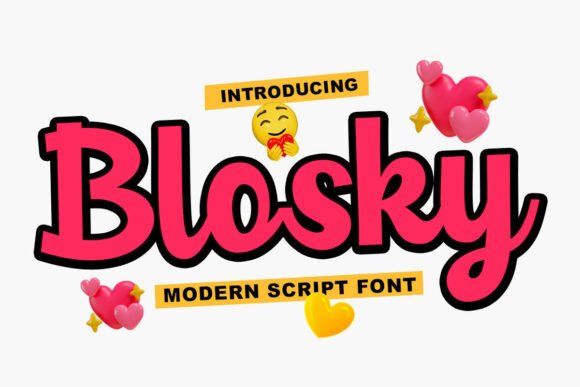
Typography is no longer just about legibility—it’s about resonance. In a digital landscape saturated with uniform sans-serifs and over-polished minimalism, designers are turning to expressive script fonts not as decorative afterthoughts, but as strategic tools for emotional connection. Enter Blosky Script: a modern script font built for clarity of voice, not just visual flair. It doesn’t mimic handwriting—it reimagines it: bouncy, confident, and consistently energetic without sacrificing structure or scalability.
More Than a Font—A Visual Tone of Voice
Blosky Script stands apart because it balances spontaneity with intention. Its thick, rounded strokes and gentle swashes aren’t random; they’re engineered for rhythm and readability at display sizes. Unlike many script fonts that collapse into illegibility below 36pt, Blosky maintains its personality even when scaled down for mobile banners or app icons—making it unusually versatile for today’s cross-platform workflows. That’s critical for creators who design once and deploy everywhere: from Instagram Stories to café chalkboard menus, from Shopify product labels to classroom posters.
What makes Blosky feel “alive” isn’t just its curves—it’s its consistency in character. Each letterform carries the same buoyant weight and slight tilt, creating visual harmony across words. That cohesion matters when building brand identity: a logo using Blosky Script reads as joyful *and* intentional—not whimsical *or* chaotic. For small business owners launching a new bakery, a children’s apparel line, or an eco-friendly skincare brand, that distinction is practical, not theoretical. It means less time explaining tone to clients and more time refining color palettes or user flows.
Why Playfulness Is Now a Professional Priority
Playfulness has evolved from a stylistic choice to a functional response to shifting audience expectations. Adults aged 25–45 increasingly favor brands that signal authenticity over austerity—and that includes typography. A 2023 Adobe Creative Cloud survey found that 68% of marketers reported higher engagement when using expressive type in social campaigns targeting Gen Z and younger millennials. But it’s not just about youth appeal. Educators use Blosky Script in lesson slides to reduce cognitive load; therapists incorporate it into wellness handouts to soften clinical messaging; freelance illustrators pair it with custom line art to unify visual storytelling.
This shift reflects broader lifestyle changes: attention spans are fragmented, but emotional recall is durable. People remember how something made them feel far longer than what it said. Blosky Script leverages that reality. Its bubbly lines and springy ascenders trigger subtle positive associations—think of the warmth of a handwritten birthday card or the excitement of a festival poster. That’s not nostalgia; it’s neuro-informed design. And unlike retro scripts that risk feeling dated or overly literal, Blosky feels current because it’s digitally native—optimized for screen rendering, variable-axis compatibility, and responsive environments.
Real-World Use Cases—Beyond the Obvious
Most designers reach for Blosky Script first for headlines and logos—and rightly so. But its utility extends further, especially when paired thoughtfully with supporting typefaces. Here’s where it shines in practice:
- Food & beverage branding: A juice bar’s packaging gains approachability with Blosky Script on the front label, while body text uses a clean, airy sans-serif like Inter or Manrope. The contrast reinforces freshness without compromising scannability.
- Educational materials: Teachers designing printable flashcards for early readers use Blosky Script for target words (“sun,” “jump,” “happy”)—its exaggerated forms support letter recognition, while its friendly tone reduces learning anxiety.
- Event promotion: Wedding invitations, community festivals, or pop-up markets benefit from Blosky Script’s celebratory cadence. When used sparingly—for names, dates, or taglines—it adds warmth without overwhelming layout hierarchy.
- Digital interfaces: Not for body copy—but perfect for micro-interactions: a “Yay!” confirmation message after form submission, a playful loading state (“Almost there… 🎉”), or a CTA button labeled “Let’s Go!”
The key is restraint. Blosky Script works best when it anchors emotion—not when it competes with information. That means avoiding full paragraphs, dense blocks of text, or low-contrast color combinations (e.g., light yellow on white). It thrives against ample negative space and complementary neutral tones: warm grays, oatmeal, deep navy, or terracotta.
Workflow Integration—No Overhead, Just Impact
Modern designers don’t have time for finicky fonts. Blosky Script is built for today’s tools: available in OpenType format with standard ligatures, stylistic alternates, and multilingual support (including extended Latin and basic Cyrillic). It imports cleanly into Figma, Adobe Creative Cloud, and web projects via @font-face or variable font files. No plugin required. No licensing surprises—most plans include desktop, web, and app usage rights, making it viable for freelancers quoting fixed-price projects and agencies managing multi-client assets.
For developers embedding Blosky Script in websites, it performs well with font-display: swap, ensuring fast load times without sacrificing visual fidelity. Pair it with system-ui or a lightweight variable sans for responsive typography systems—no need to load multiple weights. That efficiency supports both accessibility goals (consistent sizing, clear contrast) and Core Web Vitals benchmarks.
Not a Trend—A Tool With Longevity
Script fonts come and go, but Blosky Script avoids trend dependency by solving real problems: how to convey joy without cliché, how to stand out without shouting, how to humanize digital experiences without sacrificing polish. Its staying power lies in adaptability—not novelty. As AI-generated visuals flood feeds, hand-crafted texture and intentional imperfection become more valuable, not less. Blosky Script delivers that texture with precision, not guesswork.
That said, it’s not universal. It won’t suit law firm stationery, enterprise SaaS dashboards, or academic journals. And that’s its strength: clarity of purpose. Choosing Blosky Script signals a deliberate decision—to prioritize warmth, invite interaction, and reflect a brand’s genuine spirit. For creators balancing commercial goals with creative integrity, that alignment saves time, builds trust, and ultimately, deepens impact.
Getting Started—Thoughtfully
If you’re exploring Blosky Script for the first time, start small. Replace one headline in an existing project—not to overhaul, but to observe how it shifts tone. Test it across devices. Ask a colleague or client: “What emotion does this evoke?” Compare it side-by-side with alternatives: Does it feel more inviting? More memorable? Less generic?
Then consider pairing. Blosky Script pairs naturally with geometric sans-serifs (like Poppins or IBM Plex Sans), warm grotesques (such as Montserrat or Nunito), or even restrained serifs (Cormorant Garamond for contrast). Avoid competing scripts or overly decorative fonts—let Blosky lead, then support with calm, functional type.
Finally, remember: typography serves people, not platforms. Blosky Script works because it respects that principle—it doesn’t shout for attention; it extends a hand. In a world craving sincerity over slickness, that kind of quiet confidence is rare. And increasingly, essential.