Talkzome: The Playful, Hand-Drawn Font That Brings Warmth to Every Design
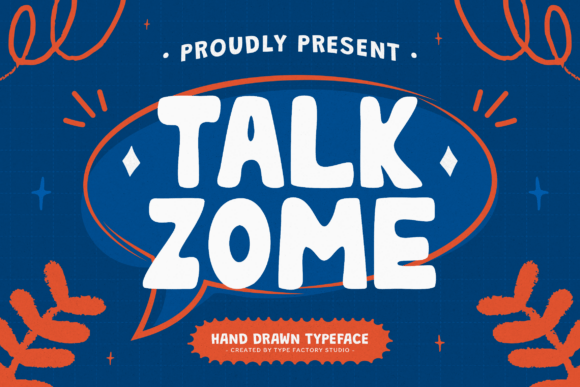
Imagine a font that doesn’t just sit on the page—but smiles, wiggles, and invites you in. That’s Talkzome. It’s not another rigid geometric sans or a stately serif meant for formal reports. Talkzome is a hand-drawn display font built from soft, rounded shapes and irregular strokes—like something sketched quickly with a thick marker by a friendly artist who really likes coffee and kids’ laughter. Its personality isn’t manufactured; it’s baked right into the curves and quirks of each letter.
What Makes Talkzome Feel So Approachable?
At its core, Talkzome thrives on imperfection—and that’s its greatest strength. Unlike fonts designed for maximum legibility at tiny sizes or pixel-perfect digital rendering, Talkzome leans into organic variation. Uppercase “A” might tilt slightly left; lowercase “g” could have a loop that swells just a little more than the one before it. These subtle inconsistencies aren’t flaws—they’re cues. They signal warmth, humanity, and spontaneity.
The rounded terminals, generous counters, and open apertures make letters feel light and airy—not cramped or technical. Even punctuation marks carry the same playful weight: periods are gentle dots, exclamation points bounce upward like tiny springs, and quotation marks curve like happy parentheses. This consistency across the entire character set—letters, numbers, symbols, ligatures—means designers don’t have to switch fonts mid-sentence to keep tone intact.
Where Does Talkzome Shine in Real Projects?
Talkzome isn’t a one-trick pony hiding in the “fun fonts” folder. It’s purpose-built for contexts where authenticity and emotional resonance matter more than sterile precision.
- Kids’ design: From illustrated storybook covers to classroom posters and early-learning apps, Talkzome feels like a trusted friend—not a teacher’s chalkboard script. Its soft edges reduce visual fatigue for young eyes, and its friendly rhythm supports early reading without overwhelming.
- Packaging for lifestyle brands: Think artisanal snacks, eco-friendly toys, or small-batch skincare. Talkzome adds instant charm to product labels and shelf tags—helping brands stand out in crowded retail aisles while reinforcing values like care, craft, and playfulness.
- Merchandise & apparel: T-shirts, tote bags, enamel pins—anything meant to be worn, carried, or shared benefits from Talkzome’s tactile energy. Its hand-drawn nature translates beautifully to screen printing and embroidery, where slight variations add character rather than error.
- Branding for creative studios & indie makers: A graphic designer launching their own studio, a ceramicist building an online shop, or a podcast host crafting show art—all find Talkzome a natural extension of their voice. It says, “I’m skilled, but I’m also human.”
More Than Just Looks: Practical Features That Matter
A playful font is only useful if it’s actually usable—and Talkzome delivers where it counts. It includes full uppercase and lowercase Latin alphabets, standard numerals and punctuation, plus thoughtful extras:
- Ligatures that enhance flow in connected words (like “fi”, “fl”, or custom combinations), adding polish without sacrificing charm.
- Multilingual support covering Western, Central, and Eastern European languages—making it viable for global campaigns, bilingual children’s books, or EU-based packaging compliance.
- OpenType features that let designers toggle stylistic alternates, contextual swashes, or old-style figures depending on context—so the same font can shift subtly between a birthday card and a boutique website headline.
That means no workarounds. No swapping in dingbat fonts for accents or manually adjusting spacing to fix awkward collisions. Talkzome is production-ready—not just concept-ready.
Fitting Talkzome Into Your Workflow (Without the Headache)
Designers often worry about playful fonts being hard to pair or difficult to scale. With Talkzome, the opposite is true. Because its personality is so clearly defined, pairing becomes intuitive—not arbitrary.
Try setting Talkzome as your headline font alongside a clean, neutral sans-serif (like Inter, Lato, or even system fonts like SF Pro or Segoe UI) for body text. The contrast does heavy lifting: Talkzome grabs attention and sets mood; the supporting font ensures clarity and readability. For print layouts, use it at 36pt and up for maximum impact—its irregular forms bloom at larger sizes.
In digital spaces, Talkzome works best as a display face—not for paragraphs or navigation menus. Use it for hero section headlines, CTA buttons (“Let’s Play!”, “Grab Yours”), or animated SVG text reveals. Just avoid using it below 24px on screen unless you’re going for intentional texture over legibility.
And yes—it’s web-friendly. When self-hosted or loaded via modern font services, Talkzome renders smoothly across browsers and devices. Its file size stays lean thanks to smart glyph optimization, so performance doesn’t suffer just because the type feels joyful.
Why Designers Choose Talkzome Over Other Playful Fonts
There are dozens of “handwritten” or “rounded” display fonts out there. So why does Talkzome consistently earn repeat use? Three reasons stand out:
- It avoids cliché. No forced wobbles, no exaggerated drips or splatters, no cartoonish exaggeration. Its playfulness comes from proportion and rhythm—not gimmicks.
- It scales emotionally. A child sees kindness. A parent sees trust. A retailer sees market differentiation. A brand strategist sees tone-of-voice alignment. Talkzome communicates across audiences without translation.
- It respects the designer’s time. No need to manually nudge kerning pairs or redraw glyphs for multilingual clients. The thoughtfulness is already embedded—in the spacing, the language coverage, the OpenType logic.
Real-World Scenarios Where Talkzome Made the Difference
A Brooklyn-based toy company redesigned their holiday campaign around a custom Talkzome wordmark—“Joy Box”—with alternating swash capitals. The result? A 27% lift in social engagement, with customers tagging friends saying, “This font made me *feel* the season.”
An Australian early childhood education app replaced their generic rounded font with Talkzome for all onboarding illustrations and button labels. Teachers reported faster student recognition of interactive elements—and fewer support tickets about “confusing buttons.”
A sustainable stationery brand used Talkzome across product tags, thank-you cards, and Instagram stories. Their customer survey revealed that 68% associated the brand with “thoughtfulness” and “approachability”—traits directly tied to the font’s visual warmth.
Things to Keep in Mind Before You Use Talkzome
Like any strong personality, Talkzome isn’t right for every situation. It’s not ideal for legal disclaimers, academic journals, or enterprise dashboards where neutrality and authority take priority. And while its multilingual support is broad, always test diacritics in your target languages—especially for less common accented characters.
Also, remember: Talkzome is a display font first. Don’t force it into roles it wasn’t built for. Let it shine where tone matters most—headlines, logos, invitations, packaging fronts, and moments that deserve a little extra joy.
When you choose Talkzome, you’re not just picking a typeface. You’re choosing a collaborator—one that brings empathy, energy, and ease to your next project. Whether you're designing for a five-year-old’s first book or a founder’s dream brand, Talkzome reminds us that great typography doesn’t have to be serious to be smart.