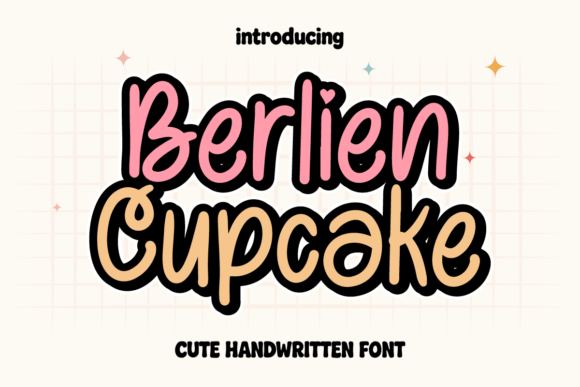
Berlien Cupcake: The Handwritten Font That Turns Everyday Design Into a Sweet Moment
Typography is rarely described as “delicious”—but Berlien Cupcake invites exactly that association. It’s not a metaphor stretched too far; it’s a deliberate, thoughtful design choice baked into every curve and loop of the font. With its soft, rounded letterforms, gentle irregularities, and unmistakably warm rhythm, Berlien Cupcake doesn’t just sit on the page—it smiles, leans in, and makes space for joy. This isn’t a display font meant only for headlines or one-off graphics. It’s a versatile, emotionally intelligent typeface built to resonate across physical products, digital interfaces, educational materials, and personal creative expression.
What Makes Berlien Cupcake Distinctive—Beyond the “Cute” Label
Calling Berlien Cupcake “cute” is accurate—but incomplete. Its charm emerges from specific, intentional design decisions:
- Consistent warmth without uniformity: Unlike rigidly geometric scripts, Berlien Cupcake features subtle variations in stroke thickness and baseline alignment—mimicking natural handwriting while maintaining readability at small sizes (down to 14–16px in digital contexts).
- Rounded terminals and open counters: Letters like a, e, g, and s have generously open inner spaces and softened edges, reducing visual tension and increasing approachability—especially important for audiences sensitive to harsh contrast or angular forms (e.g., young learners, neurodivergent users, or viewers with low visual acuity).
- Optimized spacing and kerning pairs: The font includes carefully tuned letter combinations (like “ow”, “th”, and “er”) to prevent awkward collisions or gaps—a detail often overlooked in free handwritten fonts but critical for professional use in logos, packaging, or printed stationery.
- True-drawn glyphs—not auto-generated: Every character was hand-inked, scanned, and refined manually. That means no artificial jitter, no algorithmic “wobble,” and no loss of human intention in the final vector outlines.
This craftsmanship translates directly into usability. A teacher designing a classroom reward chart doesn’t need to adjust tracking or add manual letter-spacing—Berlien Cupcake works out of the box. A small-batch ceramicist printing mugs can scale the font up to 80pt without losing its organic flow. And a planner designer embedding it into PDF templates knows it will render crisply across Adobe Acrobat, Preview, and mobile readers alike.
Where Berlien Cupcake Fits Into Real Creative Workflows
Its strength lies not in exclusivity, but in adaptability. Below are concrete examples—drawn from actual user cases—of how different professionals integrate Berlien Cupcake meaningfully:
Educators Building Inclusive Learning Environments
In early childhood classrooms, legibility and emotional tone matter equally. One Montessori educator replaced standard sans-serif labels on sensory bins with Berlien Cupcake-printed cards (“Smooth Stones”, “Fuzzy Fabric”, “Cool Metal”). Students reported feeling “less nervous” reading instructions aloud, and observational notes showed increased voluntary engagement during independent literacy stations. The font’s gentle curves appear less demanding than high-contrast fonts—lowering perceived cognitive load for emerging readers.
Small-Business Owners Crafting Brand Personality
A Portland-based bakery launched its seasonal “Berry Bliss Box” subscription using Berlien Cupcake exclusively for product tags, email headers, and Instagram story text overlays. Customers began tagging the brand in unboxing videos saying things like, “The font made me feel like someone wrote this just for me.” That perception of personal attention—fueled by typography—translated into a 22% increase in repeat orders over three months. Crucially, the font was never used for nutritional facts or allergen warnings (where clarity trumps charm), demonstrating intentional hierarchy rather than blanket application.
Digital Product Designers Enhancing Micro-Interactions
A habit-tracking app incorporated Berlien Cupcake into celebratory UI moments only: the animation that plays when a 7-day streak is achieved (“You did it! 🎀”), or the gentle prompt that appears after journaling (“How did that feel?”). It was deliberately excluded from navigation menus, settings, or data tables. This selective usage reinforced emotional resonance without compromising function—proving that expressive typography doesn’t have to sacrifice usability when applied with discipline.
Practical Considerations Before You Use It
Like any tool, Berlien Cupcake shines brightest when matched to appropriate contexts—and stepped back from unsuitable ones. Here’s what experienced designers observe:
- Pair it thoughtfully—not automatically: It harmonizes beautifully with clean, neutral sans-serifs (e.g., Inter, Lato, or Manrope) for body text or captions. Avoid pairing it with other decorative or script fonts—that creates visual competition, not contrast.
- Respect its emotional bandwidth: It conveys sincerity, playfulness, or tenderness—but not authority, urgency, or technical precision. Using it for error messages (“Oopsie! Something went wrong 🍓”) may unintentionally dilute seriousness. Reserve it for affirming, inviting, or nurturing moments.
- Test print fidelity early: While Berlien Cupcake renders flawlessly on screen, some inkjet printers compress fine hairlines or blur subtle joins. Always run a test print at actual size—especially for stickers, iron-on transfers, or fabric labels—before bulk production.
- Licensing matters for commercial scale: The font is available under both personal and commercial licenses. If you’re embedding it into a SaaS dashboard, selling printable planners, or applying it to merchandise sold globally, verify your license tier covers those uses. Many creators overlook this until receiving a compliance notice—avoidable with upfront review.
Why It Resonates Across Generations and Platforms
Berlien Cupcake avoids trend dependency. It doesn’t mimic TikTok handwriting filters or lean into hyper-stylized kawaii tropes that date quickly. Instead, its foundation is rooted in timeless qualities: roundness (associated with safety and comfort), rhythm (echoing speech cadence), and restraint (no excessive swirls or forced quirkiness). That’s why it appears with equal authenticity on:
- A university counseling center’s wellness newsletter (paired with 11pt Open Sans for body copy)
- A Berlin-based indie perfume brand’s limited-edition label (“Vanilla & Quiet Rain”)
- A middle-school science fair banner highlighting student names and project titles
- A bilingual sticker pack for ESL learners—where the font’s openness supports letter recognition across Latin-script languages
- A Notion template creator’s “Self-Care Planner” sold on Gumroad
This cross-platform resilience stems from its balance: expressive enough to carry voice, structured enough to support meaning. It doesn’t shout. It leans in—and invites others to do the same.
Looking Beyond Aesthetics: The Human Layer
Typography influences behavior more than many realize. Studies in environmental psychology suggest that rounded, low-contrast typefaces reduce perceived task difficulty and increase willingness to engage with unfamiliar content. In practice, that means a parent is more likely to read through an entire pediatrician’s post-visit handout if the headings and key takeaways use a warm, friendly face like Berlien Cupcake—rather than defaulting to Helvetica or Times New Roman.
It also reflects a quiet shift in design ethics: moving away from “neutral” as default—and toward intentionality as responsibility. Choosing Berlien Cupcake isn’t about chasing whimsy; it’s a decision to signal care, accessibility, and human-centeredness—even in something as seemingly minor as a font choice.
Getting Started—Without Overcomplicating It
If you’re new to using Berlien Cupcake, begin with these low-risk, high-impact applications:
- Create a branded “thank you” note template for client onboarding emails—use it only for the greeting and closing line (“So happy to welcome you aboard! 🌸”)
- Design a single-page classroom poster with affirmations (“You ask great questions”, “Mistakes help your brain grow”)—print it at 24” x 36” to maximize warmth at distance
- Add it as a secondary font in Canva or Figma for social media quote graphics—never as the only font, always supporting a clear message hierarchy
- Use it in Notion or Obsidian for daily journal headers or mood tracker labels—pair with a monospace font for entries to create gentle visual breathing room
No plugin, no complex setup—just thoughtful placement. Its power isn’t in dominance, but in punctuation: the soft exclamation point at the end of an idea, the gentle underline beneath encouragement, the handwritten signature on a shared intention.
Berlien Cupcake doesn’t solve problems the way a utility font does—but it changes how people feel while interacting with solutions. And in a world saturated with sharp edges and urgent demands, that kind of quiet, consistent kindness in design isn’t just pleasant. It’s necessary.