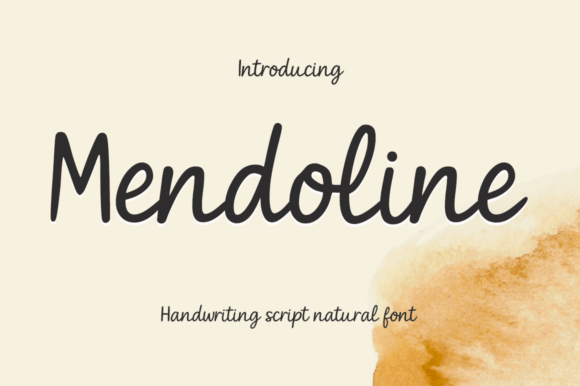
Mendoline Handwritten Script Font
Mendoline is a carefully crafted handwritten script font designed to replicate the natural rhythm and variation of authentic pen-on-paper writing. It features fluid strokes, subtle inconsistencies in stroke weight, and gracefully connected letterforms that avoid mechanical uniformity. Unlike many script fonts that prioritize decorative flair over functionality, Mendoline balances expressiveness with legibility—making it suitable for both display and moderate-length typographic applications.
People often seek fonts like Mendoline when aiming to communicate warmth, approachability, or artisanal quality. Designers working on branding for lifestyle businesses, wedding stationery, boutique packaging, or curated social media visuals may evaluate Mendoline for its ability to convey sincerity and human touch. Its organic character helps differentiate visual identity in saturated digital spaces where clean sans-serifs dominate.
One primary benefit of Mendoline lies in its stylistic cohesion. The font includes standard ligatures, contextual alternates, and a full set of uppercase and lowercase characters, supporting consistent typographic hierarchy across projects. Its open counters and moderate x-height contribute to better readability at larger sizes—especially important for invitations, signage, or hero text in web banners. Additionally, Mendoline’s design avoids exaggerated flourishes, reducing the risk of visual clutter in layouts requiring subtlety.
However, practical tradeoffs exist. As a script font, Mendoline is not intended for body text or extended reading. Its connected letterforms and variable spacing can reduce legibility below 24–30px, particularly in digital interfaces with variable screen resolutions or rendering engines. Users should also consider language support: Mendoline covers Latin-based scripts (including accented characters used in French, Spanish, and German), but does not extend to Cyrillic, Greek, or Asian language systems. Projects requiring multilingual typography may need supplemental typefaces.
Another consideration is licensing and technical compatibility. Mendoline is typically distributed as a desktop font (OTF or TTF) and may require separate web font licensing for use in live websites. Embedding via @font-face demands attention to file size, fallback behavior, and performance impact—especially on mobile connections. Designers integrating Mendoline into CMS-driven sites or email templates should verify rendering consistency across platforms, as some email clients do not support custom web fonts reliably.
Mendoline tends to be a strong fit in specific contexts. For example, it excels in logo design for small businesses centered around personal service—such as yoga studios, independent bakeries, or handmade goods brands—where conveying authenticity aligns with brand values. It also works well in print-based collateral like wedding save-the-dates, boutique product labels, or limited-edition book covers, where tactile quality and intentional design choices matter. Social media creatives may use Mendoline selectively—for quote graphics, Instagram story highlights, or branded headers—provided contrast and sizing ensure clarity on small screens.
Conversely, alternatives may be preferable in other scenarios. If a project requires high legibility at smaller sizes—like app interface labels, data dashboards, or accessibility-focused content—a more neutral, highly legible sans-serif (e.g., Inter, Open Sans, or Lato) would serve better. Similarly, if brand guidelines demand strict typographic versatility—including monospace, condensed, or variable-weight options—Mendoline’s singular style limits flexibility. In those cases, pairing a functional workhorse font with a restrained script accent (rather than relying solely on Mendoline) often yields more balanced results.
Designers evaluating Mendoline should first clarify their core typographic needs. Ask: Is the priority expressive tone or functional clarity? Will this font appear in static assets only, or must it scale responsively across devices? Does the project involve multilingual content or strict accessibility requirements? Testing Mendoline in real context—setting actual headlines, checking contrast ratios, previewing on multiple devices—provides more insight than aesthetic evaluation alone.
It’s also useful to compare Mendoline against similar script fonts before committing. Consider how its stroke contrast compares to fonts like Playfair Display (which blends serif elegance with script-like flow) or Quicksand (a rounded sans-serif offering friendliness without cursive complexity). Each serves different communicative goals—even subtle differences in letter spacing, baseline alignment, or terminal treatment affect perceived tone and usability.
Licensing is another practical checkpoint. While many designers assume “purchased font = universal usage,” Mendoline’s license terms often distinguish between desktop, web, app, and server use. Commercial projects—especially SaaS platforms or client deliverables involving embedded fonts—require explicit permission for each deployment method. Reviewing the foundry’s license documentation prevents compliance issues later.
Finally, consider long-term maintainability. Fonts like Mendoline are best deployed intentionally—not as default choices, but as deliberate accents. Overuse dilutes impact; inconsistent application (e.g., mixing Mendoline with clashing type families) can undermine professionalism. A disciplined approach—using it for one key element per layout (a logo, headline, or call-to-action)—preserves its distinctiveness while supporting cohesive visual communication.
In summary, Mendoline offers a refined, handwriting-inspired option for designers seeking authenticity without sacrificing polish. Its value emerges most clearly when matched to projects where human-centered expression matters more than typographic neutrality—and when technical, linguistic, and functional constraints have been realistically assessed. Evaluating it alongside concrete use cases, rather than abstract aesthetics, leads to more confident, purposeful typography decisions.