Deatom Lettering: Elevating Brand Voice Through Thoughtful Handwritten Typography
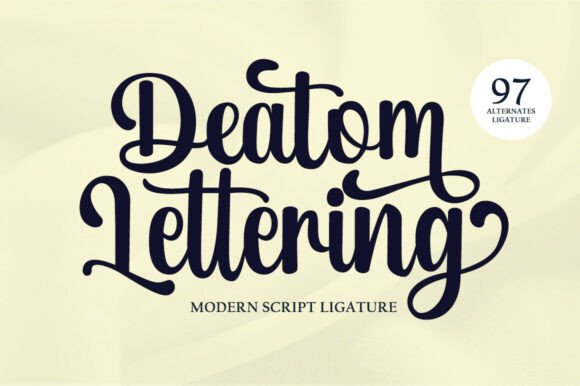
In an era where authenticity and human connection drive engagement, typography has evolved far beyond functional legibility—it’s become a strategic voice. Among the most compelling developments in contemporary type design is Deatom Lettering, a meticulously crafted handwritten calligraphy font that bridges artisanal craftsmanship with digital precision. Designed with a distinctively feminine, elegant, and expressive sensibility, Deatom Lettering isn’t merely decorative; it’s a responsive typographic tool built for creators who understand that every letter carries intention.
A Typeface Engineered for Expressive Consistency
At its core, Deatom Lettering is more than a single stylistic choice—it’s a system. Available in both regular and bold weights, the font delivers visual hierarchy without sacrificing harmony. What truly distinguishes it is its extensive OpenType glyph library. Each character includes multiple contextual alternates—swash capitals, flourished terminals, ligature-rich combinations, and stylistically nuanced lowercase forms. These aren’t hidden extras; they’re intelligently accessible in professional applications like Adobe Illustrator, Affinity Designer, and modern web-based tools that support OpenType features.
For example, typing “love” doesn’t yield a static sequence—it dynamically adjusts based on adjacent characters, offering subtle variations in entry strokes, exit loops, and baseline rhythm. This behavior mirrors natural handwriting, where repetition rarely means replication. The result? Designs that feel hand-crafted at scale—without manual redrawing or tedious glyph substitution.
Why Designers and Brands Are Turning to Handwritten Elegance
The rise of Deatom Lettering reflects deeper shifts across creative and commercial landscapes. Consumers increasingly gravitate toward brands that signal care, individuality, and warmth—qualities historically conveyed through analog touchpoints like hand-lettered packaging, personalized stationery, or bespoke signage. Yet mass-market expectations demand speed, scalability, and cross-platform consistency. That tension—between craft and efficiency—is where Deatom Lettering delivers tangible value.
Consider a boutique skincare brand launching a limited-edition serum. Its campaign requires cohesion across Instagram carousels, Shopify product pages, email headers, and printed hang tags. Using a static script font would risk visual fatigue or mechanical repetition. With Deatom Lettering, designers can generate dozens of unique headline variants from one text layer—ensuring each social post feels intentional, not templated. The same file adapts seamlessly to high-resolution print or responsive web rendering, maintaining its organic flow without pixelation or loss of nuance.
Aligning With Evolving Creative Workflows
Modern creative workflows prioritize flexibility without fragmentation. Freelancers juggle client revisions across time zones; in-house marketing teams iterate rapidly across channels; founders building DTC brands need production-ready assets in hours—not days. Deatom Lettering integrates natively into these realities. Its OpenType-powered variability eliminates the need for separate “alternate” font files or layered Photoshop mockups. A single .OTF file becomes a dynamic toolkit—reducing asset sprawl, version control headaches, and export inconsistencies.
This efficiency gains further relevance as design systems mature. Where once “brand fonts” meant two sans-serifs and a display accent, today’s standards include expressive variables: a primary voice for body copy, a secondary for quotes or testimonials, and a third—like Deatom Lettering—reserved for moments demanding emotional resonance. It functions less as decoration and more as punctuation: a deliberate pause, a confident flourish, a gesture of sincerity.
More Than Aesthetic: The Psychology of Handwritten Trust
Research in behavioral design consistently shows that handwritten elements trigger higher perceived trustworthiness and approachability. A 2023 study published in the Journal of Consumer Psychology found that consumers rated products with handwritten labels as 27% more “caring” and 19% more “authentic” than identical items with clean sans-serif labeling—even when the content was identical. This isn’t nostalgia—it’s neurocognitive response. Our brains recognize handwritten forms as signals of human presence, effort, and attention to detail.
Deatom Lettering leverages this instinct—but with intentionality. Unlike overly ornate scripts that sacrifice readability or minimalist handwritten fonts that lack distinction, Deatom balances grace with clarity. Its generous x-height, open counters, and consistent stroke contrast ensure legibility at small sizes (think email subject lines or mobile app buttons), while its expressive terminals and rhythmic spacing shine at larger scales (book covers, event signage, hero banners).
Practical Integration Across Platforms
Adoption isn’t theoretical—it’s operational. Here’s how professionals are applying Deatom Lettering today:
- Entrepreneurs embed it in Canva templates for branded pitch decks, using OpenType alternates to rotate headline treatments across investor-facing slides—keeping messaging fresh without redesigning layouts.
- Freelance lettering artists use it as a foundational layer for custom illustrations, then selectively override glyphs with hand-drawn elements—accelerating delivery while preserving uniqueness.
- Digital marketers pair it with variable sans-serifs (like Inter or Manrope) in CSS-driven landing pages, applying
font-variant-numericandfont-feature-settingsto activate swashes only on H1s and CTAs—creating hierarchy rooted in typographic empathy. - Print studios leverage its robust hinting and PostScript outlines to output crisp foil-stamped business cards and embossed wedding invitations—no raster fallbacks required.
Crucially, Deatom Lettering avoids the pitfalls of trend-chasing. Its elegance isn’t tied to a fleeting aesthetic cycle; it’s grounded in enduring principles of calligraphic proportion, ink-trail physics, and spatial rhythm. That timelessness makes it viable for annual reports, legacy rebrands, and multi-year brand guidelines—not just seasonal campaigns.
Looking Ahead: Typography as Strategic Infrastructure
As AI-generated visuals proliferate, the demand for irreplaceably human qualities intensifies. Algorithms can mimic brushstrokes, but they struggle with the quiet confidence of a well-placed terminal, the asymmetry of a balanced flourish, or the breath-like pacing between words. Deatom Lettering represents a counterpoint: not anti-technology, but pro-intention. It empowers creators to embed humanity into scalable systems—proving that sophistication and warmth aren’t mutually exclusive.
This aligns with broader industry movement toward “ethical typography”—a growing practice where font selection considers cultural resonance, accessibility implications, environmental impact (lighter font files reduce data transfer), and labor ethics (supporting independent type designers). Deatom Lettering fits naturally here: it’s developed by a small studio committed to sustainable licensing, offers clear documentation for screen reader compatibility testing, and includes language-supporting diacritics for global English-language markets.
For professionals navigating complexity—whether scaling a creative agency, launching a lifestyle brand, or refining a personal portfolio—the value isn’t in owning another font. It’s in accessing a thoughtful, responsive, and deeply human typographic partner. Deatom Lettering doesn’t shout for attention. It invites closer reading. It rewards careful application. And in doing so, it transforms text from information into invitation.
That shift—from utility to relationship—isn’t just where typography is headed. It’s where meaningful communication has always lived.