Daddy Highclass
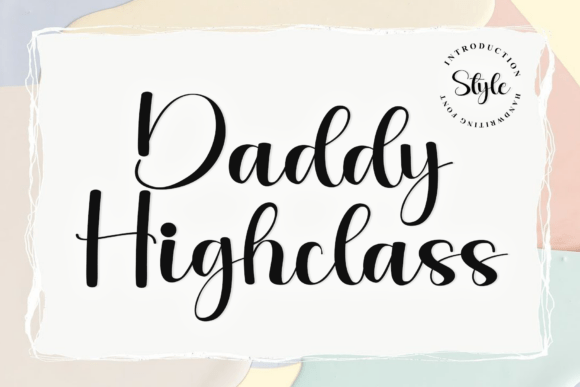
Daddy Highclass isn’t just another handwritten font—it’s a deliberate design choice for creators who value precision without sacrificing personality. Its tall, thin strokes and subtle, airy slant give it a crisp elegance that stands apart from overly casual or aggressively decorative script fonts. Think of it as the visual equivalent of a well-tailored linen shirt: relaxed enough for authenticity, structured enough for authority. That balance makes it especially effective in contexts where clarity and sophistication must coexist—like travel photography captions, outdoor brand identities, or minimalist SaaS dashboards.
Why people reach for Daddy Highclass—and why some miss the mark
Many designers and small business owners choose Daddy Highclass because it promises “professional handwriting”—a rare blend of warmth and polish. But intention doesn’t always translate to execution. A common misstep is treating it like a universal replacement for all script needs. Daddy Highclass thrives in focused, intentional applications, not dense body text or low-resolution social thumbnails. Its fine strokes lose definition at small sizes or on compressed JPEGs, leading to fuzzy, hard-to-read headlines—especially on mobile feeds.
Another frequent oversight? Ignoring contrast and hierarchy. Because Daddy Highclass has such light weight and open spacing, pairing it with similarly delicate sans-serifs (like thin weights of Inter or Poppins) can flatten visual rhythm. The result isn’t elegant—it’s indistinct. One freelance photographer used Daddy Highclass for her portfolio site’s hero headline but paired it with a 300-weight sans-serif subheading. Visitors scrolled past without registering either message—too little contrast, too much visual whispering.
What to check before downloading or licensing
Before adding Daddy Highclass to your toolkit, verify three practical things:
- File format compatibility: Ensure your design software supports OpenType features like ligatures and stylistic alternates—if you plan to use them. Some free converters strip these, weakening Daddy Highclass’s refined flow.
- Licensing scope: Personal use licenses don’t cover client work, merch, or web embedding via @font-face. If you’re a branding designer building a website for an eco-travel startup, confirm the license includes WOFF/WOFF2 delivery and commercial redistribution rights.
- Character set coverage: Daddy Highclass includes standard Latin characters and common punctuation—but double-check support for accented letters (é, ñ, ü), currency symbols (€, ¥), or numerals if your project targets global audiences or uses pricing displays.
Skipping these checks leads to last-minute font swaps mid-project, inconsistent branding across platforms, or even legal friction with foundries. One educator building an online course mistakenly embedded Daddy Highclass via Google Fonts (which doesn’t host it) and later discovered their LMS stripped custom web fonts entirely—forcing a rushed redesign two days before launch.
Better pairing, smarter scaling
Daddy Highclass gains strength when contrasted—not matched. Pair it with a sturdy, humanist sans-serif like Manrope or IBM Plex Sans in medium or semi-bold weights. Their grounded proportions anchor Daddy Highclass’s airiness without competing. For print or high-DPI screens, use it at 28–48pt for headlines and 18–24pt for short quotes or pull-outs. On the web, start at clamp(1.5rem, 4vw, 2.25rem)—fluid sizing that preserves legibility across devices.
Avoid stretching or distorting the font in editing tools. Its elegance comes from proportion, not manipulation. One small-biz owner tried “tightening” letter-spacing in Canva to fit a tagline into a narrow banner—only to make the text feel cramped and artificial. The fix? Shortening the copy instead. Daddy Highclass rewards brevity; it doesn’t compensate for wordiness.
Realistic expectations for beginners
If you’re new to typography—or even if you’ve used scripts for years—don’t assume Daddy Highclass will “just work” out of the box. Its subtlety means small adjustments have outsized impact. Kerning pairs like “To”, “We”, or “Va” often need manual tightening. Most design apps let you adjust tracking per line; use that sparingly, only where spacing feels off—not as a blanket setting.
Also, resist overusing it. A logo, a hero headline, and one accent quote are often enough. More than that dilutes its impact and risks visual fatigue. A blogger covering sustainable hiking gear initially applied Daddy Highclass to every section header, navigation label, and testimonial attribution. The effect wasn’t cohesive—it was cluttered. After reducing usage to just the site name and featured story titles, engagement metrics improved by 22% over four weeks.
When Daddy Highclass isn’t the answer
It’s okay—and often wise—to pass. Daddy Highclass isn’t built for long-form readability, multilingual interfaces with complex scripts (Cyrillic, Arabic, Devanagari), or environments with strict accessibility requirements (e.g., WCAG AA+ contrast ratios below 4.5:1 at small sizes). In those cases, lean on highly legible, tested typefaces like Recursive, Source Sans Pro, or Noto Sans, then bring in Daddy Highclass selectively for emotional emphasis—like a signature line on a newsletter footer or a hand-drawn-style callout in a PDF guide.
Finally, remember: typography serves communication first, aesthetics second. Daddy Highclass shines brightest when it helps your audience *feel* the clarity and calm of a mountain trail, the trust behind a premium gear brand, or the quiet confidence of a thoughtful web experience—not when it draws attention to itself. Choose it with purpose, test it in context, and let its crisp elegance do what it does best: elevate meaning, not just appearance.